
FNIRSI GC-01 Geiger Counter
4.2Editor score
Built-in GM Sensor
Multi-Mode Alarm
One-Handed Operation
This guide compares ten top nuclear radiation detectors for accuracy, features, and portability to help you choose the best personal or professional radiation
Choosing the right nuclear radiation detector is essential for safety in environments where ionizing radiation might be present. Whether you are a professional working in healthcare or industry, or a concerned individual monitoring your home, having reliable equipment matters greatly.
We evaluated ten leading models based on sensor type, measurement range, ease of use, and additional features like data logging and alarms. Our comparison focuses on real-world usability and technical specifications to ensure you find a device that meets your specific monitoring needs.
Each pick below highlights key strengths and potential limitations to help you make an informed decision. Remember that prices and availability can change frequently, so check the latest details before purchasing to ensure you get the best value for your investment.
4.2Editor score

4.6Editor score

4.5Editor score
The following table provides a side-by-side comparison of the ten products reviewed in this guide, highlighting their key specifications and primary features for quick reference.




The HFS-50-CsI stands out as our top choice for serious monitoring needs due to its advanced CsI scintillator sensor. With a rating of 4.6, it delivers reliable data with minimal interference compared to traditional Geiger tubes.
We may earn a commission when you buy through this link, at no additional cost to you.
Its color screen displays a 200-second dynamic waveform curve, allowing you to visualize radiation trends instantly. The device measures dose rate, total dose, and maximum dose rate, storing up to 100 records for later review.
While the price is higher than basic models, the stability and features justify the investment. The telescopic rod helps maintain safe distance, and the long battery life ensures you can monitor for weeks without recharge.
This detector is ideal for laboratory professionals, home safety enthusiasts, and anyone needing precise environmental data. We recommend it for those who prioritize accuracy and detailed data visualization over budget constraints.
The CsI scintillator sensor offers better resistance to interference than standard Geiger-Müller tubes, ensuring more accurate readings in varied environments.
The built-in waveform curve display helps you spot sudden spikes or gradual increases in radiation levels that simple numerical readouts might miss.
We may earn a commission when you buy through this link, at no additional cost to you.
For those seeking an affordable entry into radiation detection, the FNIRSI GC-01 offers solid performance with a 4.2 rating. It uses a built-in GM sensor to detect Gamma, Beta, and X-rays effectively.
We may earn a commission when you buy through this link, at no additional cost to you.
The device features a smart alarm system with light, vibration, and sound modes, ensuring you never miss a dangerous threshold. You can set alarm values for both current and cumulative doses to suit your safety needs.
Its compact design allows for easy one-handed operation, making it convenient for quick checks around the house or during outdoor activities. The language options include English and Chinese for broader usability.
We recommend this model for beginners or casual users who need reliable alerts without breaking the bank. It is a practical choice for home monitoring where extreme precision is not the primary requirement.
The three alarm modes ensure you are alerted even if you are not looking directly at the device, providing peace of mind during sleep or work.
Settings for alarm, clock, and language are straightforward to access, allowing you to configure the device quickly without consulting the manual.
We may earn a commission when you buy through this link, at no additional cost to you.
The Radar-9989 earns its premium status with a high-precision LND7311 mica window sensor made in the USA. With a 4.5 rating, it is capable of detecting Alpha, Beta, Gamma, and X-ray radiation comprehensively.
We may earn a commission when you buy through this link, at no additional cost to you.
It supports six different measurement units, allowing professionals to track data in the format that suits their standards. The bright 3.5-inch color LCD screen ensures readability in all lighting conditions.
The package includes a telescopic rod and storage box, making it a complete kit for field use. The alarm system is visible and audible, providing robust alerts for critical radiation levels.
This detector is perfect for industrial safety teams, laboratory professionals, and serious hobbyists who need top-tier accuracy. If budget is less of a concern than performance, this is an excellent investment.
This dedicated mode allows for precise measurements of surface contamination, which is critical for industrial safety and laboratory cleaning verification.
The sliding cap provides energy compensation, enhancing measurement accuracy across a wider energy response range for more reliable dose assessments.
We may earn a commission when you buy through this link, at no additional cost to you.
The GQ GMC-300S is a trusted model known for its data logging capabilities, holding a 4.6 rating among users. It records data every second into internal memory, allowing for detailed analysis later.
We may earn a commission when you buy through this link, at no additional cost to you.
Its free data viewer software enables you to download history to your computer, making it easy to track long-term trends. The device supports multiple modes including CPM count, dosimeter, and graph modes.
The rechargeable battery lasts longer than non-rechargeable alternatives, ensuring continuous monitoring during extended projects. This feature is particularly useful for environmental surveys or site inspections.
We suggest this model for users who need to record data over time rather than just spot checks. The ability to share and analyze data on a computer adds significant value for documentation.
Downloading history to a PC allows you to use spreadsheet tools for deep analysis of radiation levels over specific time periods.
The internal memory ensures that data is not lost if the device is turned off, allowing you to pause and resume sessions easily.
We may earn a commission when you buy through this link, at no additional cost to you.
The ND01 portable radiation detector is designed for simplicity and portability, fitting easily into a pocket or backpack. It uses a clear color-coded alarm system with green, yellow, and red status indicators.
We may earn a commission when you buy through this link, at no additional cost to you.
It offers real-time value detection for timely early warnings, as well as average value detection for filtering interference. The screen is visible in both sunlight and low-light conditions, enhancing versatility.
While it carries a lower rating than other models, its design focuses on quick health protection and risk management. The automatic power-off function helps conserve battery life during intermittent use.
This unit is suitable for casual users who need a quick check for potential radiation sources in daily life. It is an uncomplicated option for those who prioritize physical size over advanced features.
The visual status indicators allow you to understand risk levels at a glance without needing to read specific numbers constantly.
Low battery warnings ensure you are never caught off guard by a dead device, prompting timely replacement of the AAA batteries.
We may earn a commission when you buy through this link, at no additional cost to you.
The Radar-9989 is a high-end option for professionals needing to detect Alpha, Beta, Gamma, and X-ray radiation. Its LND7311 sensor ensures high sensitivity and precision across various energy ranges.
We may earn a commission when you buy through this link, at no additional cost to you.
With support for six measurement units, this device offers flexibility for different industries and standards. The 270-second dose-rate waveform graph helps users visualize trends over time effectively.
The visible alarm system works even in sleep mode to alert you to potential risks immediately. Its customizable menu design meets personalized needs, allowing you to adapt settings to your workflow.
We recommend this for field safety teams and researchers who require robust data capture and alerts. The included accessories like the storage box and lanyard add to its utility in professional settings.
Instant readings upon power-on mean you do not waste time waiting for calibration or warm-up periods during critical checks.
The combination of screen alerts and audible alarms ensures you are notified even in noisy environments or if looking away.
We may earn a commission when you buy through this link, at no additional cost to you.
This detector offers a slim and lightweight design, making it easy to carry for both individual and group use. It detects Gamma, Beta, and X-rays with rapid response and high sensitivity.
We may earn a commission when you buy through this link, at no additional cost to you.
The smart alarm system allows you to set thresholds for both instantaneous and cumulative dose rates. The display remains clear even in direct sunlight, ensuring readability outdoors.
It supports long-term tracking at designated locations, which is useful for environmental monitoring. The Type-C data transfer and charging cable add modern convenience for power and data management.
This model is a balanced option for users who want portability and standard features without high costs. It fits well for home renovation checks and general environmental awareness.
The high contrast screen ensures you can read radiation levels accurately even in bright outdoor conditions where other screens might glare.
Using a Type-C cable for charging simplifies battery maintenance since many users already own compatible chargers for other devices.
We may earn a commission when you buy through this link, at no additional cost to you.
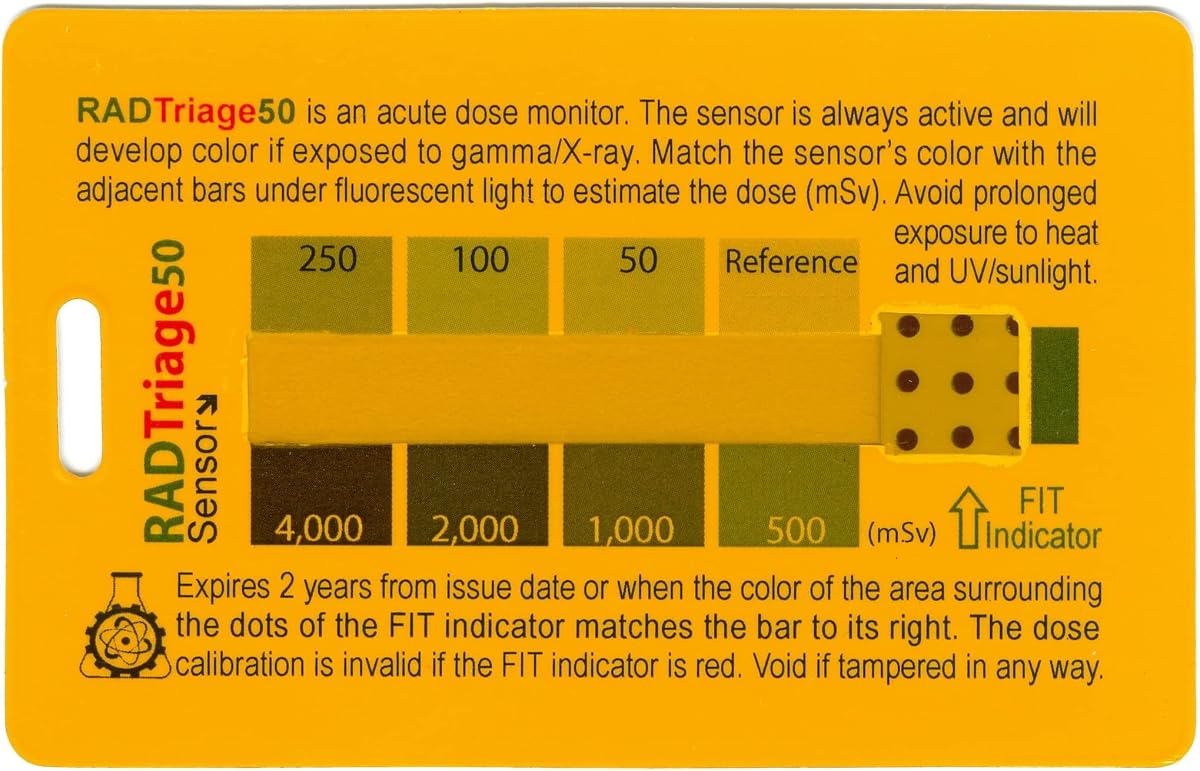
The Rad Triage 50 is designed for emergency preparedness, fitting easily in a wallet or badge holder. It detects Beta, Gamma, and X-ray radiation without needing batteries or calibration.
We may earn a commission when you buy through this link, at no additional cost to you.
It is made in the U.S.A. and meets U.S. Military-grade standards approved by the Department of Homeland Security. The device has a usable life of at least two years after removal from storage.
Storage in a freezer can extend its shelf life up to ten years, making it a reliable long-term backup. It does not provide numerical readings, acting as a threshold-based alert system.
This is the ideal choice for individuals focused on emergency scenarios rather than continuous monitoring. We recommend keeping one in every home for emergency kits to detect unexpected radiation.
Since it requires no power or setup, it is ready to detect radiation immediately in emergency situations where electronics might fail.
The wallet-sized design ensures personal detection capability is always with you without adding bulk to your daily carry items.
We may earn a commission when you buy through this link, at no additional cost to you.
The GMC-320 Plus is a specialized data recorder capable of playing back radiation data from a PC later. With a 4.6 rating, it is favored for its ability to record and analyze historical data.
We may earn a commission when you buy through this link, at no additional cost to you.
Its open communication protocol supports a wide range of radiation network setups, making it versatile for technical environments. The included PC software facilitates easy data viewing and analysis.
Technical support forums and a one-year factory warranty provide peace of mind for buyers. This unit is designed for those who need to document findings rather than just observe in real-time.
We suggest this for environmental researchers and professionals who need verifiable data logs for reports. Its networking capabilities make it a strong choice for complex monitoring setups.
The open communication protocol allows you to integrate this detector into larger networked monitoring systems for broader coverage.
Playing back data on a PC allows you to create detailed reports and share findings with colleagues or regulatory bodies easily.
We may earn a commission when you buy through this link, at no additional cost to you.
The GQ 320S offers a swivel display option, providing flexibility in how you view data on the screen. With a 4.5 rating, it includes features like real-time data logging and free PC software.
We may earn a commission when you buy through this link, at no additional cost to you.
It allows you to view data in graph mode, which helps in visualizing trends over a specific period. The rechargeable battery ensures you are not limited by disposable power sources during long monitoring sessions.
Internal memory stores your data for later download, ensuring you do not lose valuable information if you need to turn off the device. This model is highly practical for detailed radiation analysis.
We recommend it for home owners or professionals who need a balance of features and cost. The swivel display makes it easier to read from different angles in various settings.
The swivel display option allows you to rotate the screen for better visibility when the device is placed on a surface or held.
Graph mode helps you identify slow changes in radiation levels that might not be obvious from instantaneous numeric readings alone.
We may earn a commission when you buy through this link, at no additional cost to you.
Selecting the right detector involves evaluating several technical and practical factors that impact performance and ease of use in your specific situation.
The sensor is the core component that determines what types of radiation you can detect. Geiger-Müller tubes are common for Gamma and Beta detection but may not detect Alpha particles. Scintillator sensors like CsI offer better stability and resistance to interference, which is useful for professional environments.
Choose a sensor that matches your detection needs, especially if you require Alpha detection or high precision in industrial settings.
Check the device's measurement range to ensure it covers the levels you expect to encounter. Some models measure down to 0.01 μSv/h while others go up to 20 mSv/h. A wider range provides versatility for both background monitoring and high-level emergencies.
Select a range that fits your application, ensuring accuracy at both low and high radiation levels.
Alarms are critical for safety, providing visual, audible, or vibration alerts when thresholds are exceeded. Some devices allow you to set custom thresholds for current dose or cumulative dose. Multi-mode alarms ensure you are notified even if you cannot look at the screen.
Prioritize devices with customizable alarms to adapt to your specific safety limits and working environment.
Real-time monitoring is useful, but data logging allows you to track trends over time. Look for models that save data internally and offer software for downloading to a computer. This feature is essential for documentation and long-term analysis of environmental radiation.
Opt for models with memory and PC software if you need to verify data or share reports.
Continuous monitoring requires reliable power. Rechargeable batteries are convenient, but check the total operating hours offered by the device. Long battery life ensures you can perform extended surveys without needing to find a power source.
Choose a device with sufficient battery capacity for your typical monitoring sessions.
A clear display is essential for reading data in different lighting conditions. Color screens with waveforms provide more intuitive data visualization than basic LCDs. Ensure the screen is readable in sunlight if you plan to use the device outdoors.
Look for large, high-contrast displays that show data clearly in your intended working conditions.
If you need to carry the device around, weight and size matter. Some detectors are designed to fit in a pocket or badge holder, while others include telescopic rods for remote sensing. Consider how you will transport the device regularly.
Select a size that balances functionality with the convenience of carrying it daily.
Accuracy depends on the sensor and calibration. Look for devices with stated error margins, often around 10 to 30 percent. Professional models often include energy compensation to improve accuracy across different radiation energy levels.
For critical applications, choose a detector with proven accuracy standards and compensation features.
Turn on the device and allow it to stabilize before taking readings to ensure accuracy. Place the sensor close to the surface or source you wish to measure, keeping it parallel for consistent results. Always check the background radiation level in your environment first to establish a baseline.
Monitor the display for real-time readings and alarms. If an alarm triggers, move away from the source or investigate further to ensure safety. Use data logging features to keep a record of your measurements for later review.
Store the device in its protective case when not in use to prevent physical damage. Keep the battery charged or replace it as needed to ensure it is ready for emergencies. Regularly check for firmware updates or calibration needs if required by the manufacturer.
Geiger counters use tubes to detect radiation and are generally more affordable for basic use. Scintillation detectors use crystals like CsI to detect radiation and offer higher sensitivity and better energy resolution. Choose based on whether you need budget-friendly or high-precision monitoring.
Not all models can detect Alpha radiation; you need a device with a specific sensor window. Some detectors have thin mica windows that allow Alpha particles to pass through. Check the product specifications to ensure Alpha detection capability is included.
Accuracy typically ranges from 10 to 30 percent depending on the model and calibration. Professional-grade devices often have better accuracy with energy compensation. Ensure the device is calibrated properly to maintain reliable performance.
While some devices come pre-calibrated, periodic calibration ensures accuracy over time. Check the manufacturer's guidelines for recommended calibration schedules. Proper calibration is vital for professional use to meet safety standards.
For emergencies, devices like the Rad Triage 50 are designed for storage in wallets and do not require batteries. They provide threshold alerts without needing power or calibration. Consider models that are long-lasting and ready to use out of the box.
Yes, detectors can check for radiation from household items like granite or old electronics. They help monitor for potential hotspots in your living space. Choose a portable model that is easy to operate for quick home checks.
The top picks in this guide offer a range of options for different needs, from budget-friendly devices to professional-grade monitors. The HFS-50-CsI stands out for accuracy while the FNIRSI GC-01 offers an affordable entry point.
When choosing, prioritize the features that matter most to you, such as data logging, sensor type, or battery life. Consider your environment and whether you need Alpha detection or advanced alarm systems for safety.
Prices and availability may change frequently, so verify current details before purchasing. We hope this guide helps you find the right radiation detector to keep you safe and informed.