
RC Cellmeter 8
4.4Editor score
Measures 8 battery types
Large LCD for easy reading
Safe minimum operating voltage
This guide compares the top Li Ion Battery Tester models for accuracy, features, and compatibility to help you choose the right device for your needs.
Choosing the right Li Ion Battery Tester is essential for maintaining the health and safety of your rechargeable cells. Whether you manage RC drones or household gadgets, a reliable tester ensures you know exactly when to replace aging power sources.
We evaluated ten leading models based on accuracy, ease of use, and compatibility with various battery chemistries. Our analysis focuses on real-world performance metrics like capacity measurement, internal resistance, and voltage monitoring capabilities across different device types.
Each pick highlights specific strengths for different users, from hobbyists to professionals. While prices fluctuate, these tools offer lasting value by extending battery life and preventing failures. Always verify current availability before making your final purchase decision today.
4.4Editor score

4.7Editor score
4.6Editor score
This side-by-side comparison highlights key specifications and capabilities across all ten selected models. Use this table to quickly identify which device matches your specific battery chemistry and testing requirements.


The ISDT BG-8S stands out as the most versatile Li Ion Battery Tester for serious hobbyists. With a 4.7 rating, it offers comprehensive data including cell cycles and internal parameters that basic models miss.
We may earn a commission when you buy through this link, at no additional cost to you.
Its support for XT60 and balance leads ensures you can test various RC battery packs efficiently. The auto-balancing feature optimizes performance by equalizing cell voltage, which is critical for safety and longevity in high-drain devices.
One trade-off is the reliance on specific connectors, which might require adapters for older packs. However, this ensures precise data and prevents improper testing that could damage sensitive lithium cells or electronics.
If you need a tool that combines testing, balancing, and charging capabilities, this model is the definitive choice. It justifies the investment through enhanced battery lifespan and peace of mind during critical flight operations.
This feature allows deeper interaction with smart batteries, providing detailed historical data on cycles and wear to predict failure before it happens.
Users can analyze receiver signals like PWM and PPM directly through the device, eliminating the need for separate diagnostic tools in the field.
We may earn a commission when you buy through this link, at no additional cost to you.
The RC Cellmeter 8 delivers exceptional value for those seeking a reliable Li Ion Battery Tester without breaking the bank. It simplifies the testing process while maintaining the accuracy needed for daily checks.
We may earn a commission when you buy through this link, at no additional cost to you.
Its user-friendly design features a large LCD screen and a single button for measurement. This makes it accessible for anyone new to RC electronics, reducing the learning curve significantly compared to complex tools.
While it lacks advanced metrics like internal resistance, it covers essential voltage and capacity checks effectively. The safe minimum operating voltage protects batteries from damage during testing cycles.
Ideal for beginners or as a secondary field tool, this meter ensures you never fly with a dead pack unexpectedly. It proves that high utility does not always require a premium price tag.
The one-click measurement system reduces steps required to get a reading, ensuring quick checks between flights or device uses.
By setting a minimum operating voltage, it prevents draining weak cells further, preserving the remaining health of your lithium batteries.
We may earn a commission when you buy through this link, at no additional cost to you.
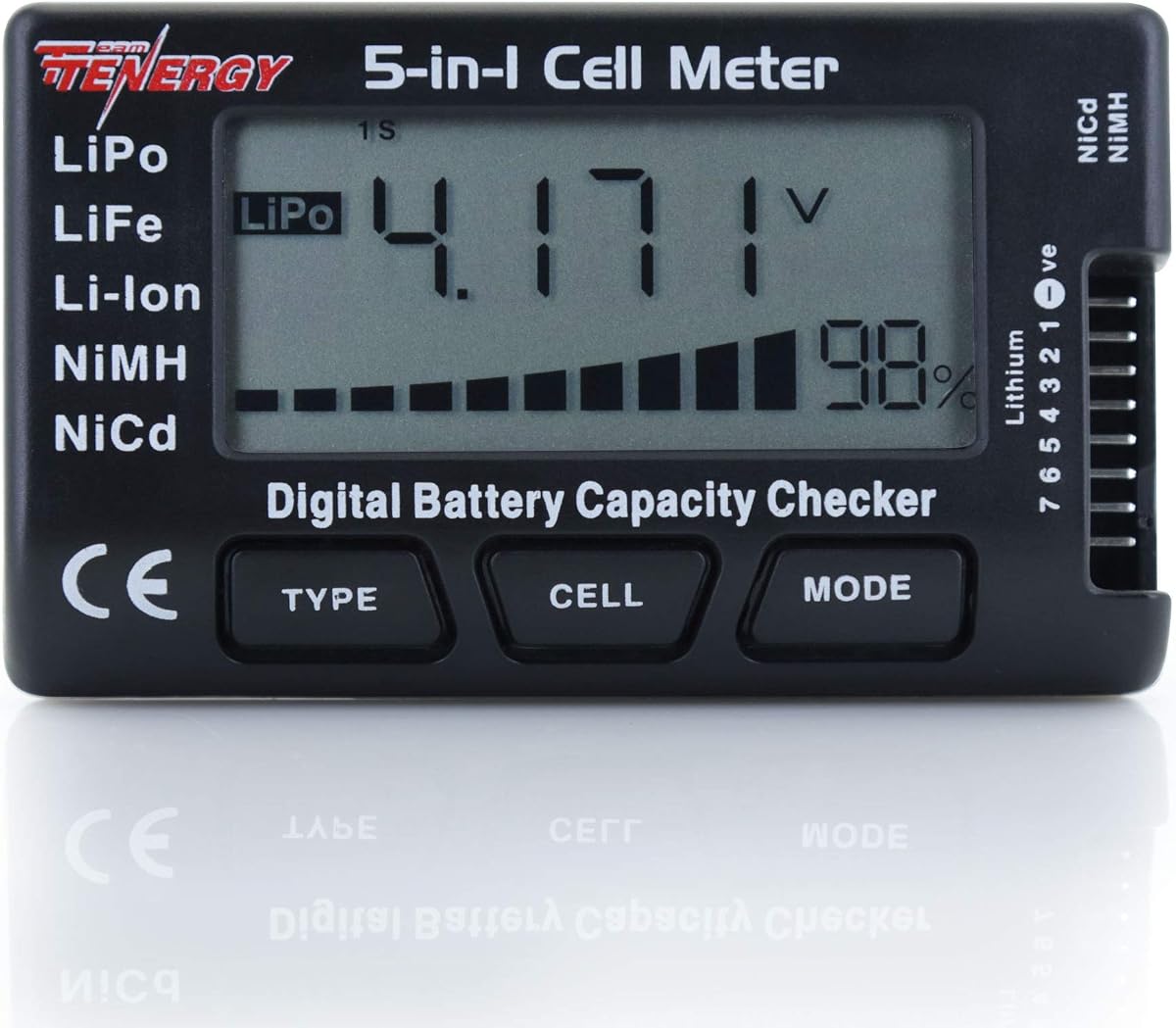
The Tenergy 5-in-1 Meter is a premium tool designed for maintaining high-performance lithium and NiMH battery packs. It stands out by providing internal resistance readings, which are crucial for assessing true cell health beyond simple voltage.
We may earn a commission when you buy through this link, at no additional cost to you.
Its balancing function ensures all cells in a series pack remain equal, preventing premature failure and extending overall runtime. This maintenance is vital for expensive drone or aircraft batteries where consistency matters.
The device draws power directly from the battery being tested, removing the need for extra batteries or cords. This makes it highly portable and ready for immediate use at any field location without setup delays.
For professionals or serious enthusiasts prioritizing long-term battery health, this meter offers essential features missing in basic testers. It ensures every cell performs optimally before you invest time in flying or driving.
Measuring resistance reveals hidden cell issues that voltage alone might miss, allowing you to identify failing cells before they cause a crash.
Since it runs on the battery pack itself, you never need to worry about carrying extra power sources for your diagnostic equipment.
We may earn a commission when you buy through this link, at no additional cost to you.
This module is specifically engineered to test 18650 cells, which are common in flashlights and vaping devices. It provides deep insights into actual capacity in mAh or MWh, not just a voltage check.
We may earn a commission when you buy through this link, at no additional cost to you.
With four independent channels, you can test multiple cells simultaneously, saving significant time during batch testing or quality control. The integrated charge and discharge function automates the full cycle measurement process.
A trade-off is the need for manual setup via a separate interface, which might be less convenient than plug-and-play tools. However, the data accuracy makes it worth the extra steps for detailed analysis.
Ideal for DIYers and technicians who need to verify cell capacity before building custom battery packs, this tester ensures you get what you pay for. It is a precise tool for those focused on lithium cylinder cells.
Testing four cells at once allows for quick comparison of performance across batches, which is ideal for sorting used or new cells.
Discharge testing reveals the actual usable energy, helping you avoid fake or degraded cells that claim high capacity but perform poorly.
We may earn a commission when you buy through this link, at no additional cost to you.
This versatile tester covers a wide range of household battery sizes, including Li-ion and alkaline. It simplifies inventory management for homes with mixed electronics, ensuring you always know which batteries are still good.
We may earn a commission when you buy through this link, at no additional cost to you.
The magnetic slot secures the battery firmly, allowing for single-handed operation that is rare in this category. This design prevents slips and makes testing even awkward shapes like button cells much safer.
Being rechargeable via USB-C eliminates the need for constant battery replacements for the tester itself. This eco-friendly feature ensures the device is always ready to use without hidden costs.
Perfect for families, this tool helps reduce waste by identifying truly dead batteries versus those that can be recycled later. It balances ease of use with reliable performance for everyday needs.
The slider locks the battery in place, allowing you to test it comfortably even with gloves or in tight spaces without holding it manually.
Using a built-in rechargeable battery ensures the tester itself never dies unexpectedly, providing consistent reliability over many years.
We may earn a commission when you buy through this link, at no additional cost to you.
This model is tailored for drone pilots who need quick, accurate data on LiPo and Li-ion packs. Its ability to connect via XT60 ensures a secure fit for large capacity batteries used in aircraft.
We may earn a commission when you buy through this link, at no additional cost to you.
The built-in balancing function automatically corrects cell voltage differences after charge, which extends the life of expensive drone batteries. This feature is essential for maintaining flight stability and safety.
It also doubles as a power bank for phones, providing high-speed charging via Qualcomm QC 3.0. This dual utility makes it a practical tool for field use where power access might be limited.
For anyone regularly flying RC aircraft, having a tester that also maintains battery health is invaluable. It reduces the risk of voltage sag mid-flight and ensures consistent performance.
The support for QC 3.0 means it can charge smartphones quickly, turning your testing device into an emergency power solution on the go.
Advanced algorithms track cycles and working parameters to give you a complete history of battery usage and wear.
We may earn a commission when you buy through this link, at no additional cost to you.
This advanced version of the BG-8S adds receiver signal analysis, which is unique among battery testers. It allows users to verify control signals alongside power metrics, ensuring the whole system works correctly.
We may earn a commission when you buy through this link, at no additional cost to you.
The device supports multiple protocols like PWM and PPM, making it adaptable to different receiver brands without extra tools. This integration saves time during flight prep by consolidating diagnostic steps.
While it has a slight learning curve due to its advanced features, the data provided is unmatched for RC professionals. It ensures both power and control systems are functioning before takeoff.
If you require comprehensive diagnostics for high-end RC setups, this meter is a powerful investment. It combines battery maintenance with receiver checking to prevent frustrating mid-air failures.
Testing receiver signals directly helps identify wiring or connection issues that might otherwise be mistaken for battery faults.
Beyond voltage, it provides cycles and cycle data that help predict end-of-life for expensive battery packs.
We may earn a commission when you buy through this link, at no additional cost to you.
This bench-top unit is designed for efficiency, allowing simultaneous testing of eight batteries. It is ideal for workshops or hobbyists with large stock, offering real-time visibility into charging and discharging status.
We may earn a commission when you buy through this link, at no additional cost to you.
The color screen displays detailed metrics for each channel, ensuring accurate capacity measurement without switching views. Active heat dissipation ensures the unit stays cool during long testing sessions.
Protection features like reverse connection guard the cells from accidental damage, which is critical when handling multiple batteries. This makes the process safer for users managing high volumes of cells.
For anyone who needs to process many 18650 cells quickly, this model provides unmatched throughput. It balances speed with accuracy, making it a reliable workhorse for serious testing.
The active cooling system allows for sustained testing without overheating, ensuring consistent accuracy over long periods.
Built-in protection prevents damage from incorrect wiring, saving expensive batteries from destruction during manual setup.
We may earn a commission when you buy through this link, at no additional cost to you.
This compact checker is built for quick on-site checks, fitting easily into a flight bag. It supports a wide range of cell counts, making it versatile for drones and cars alike.
We may earn a commission when you buy through this link, at no additional cost to you.
The display shows both total and per-cell voltages clearly, allowing pilots to spot imbalances instantly. This data helps decide if a battery is safe to fly or needs re-balancing.
While it lacks resistance testing, its reliability in showing voltage makes it a trusted companion for pilots. It prioritizes simplicity and speed, which are often more important than advanced metrics in the field.
Ideal for weekend flyers who need a dependable tool without extra bulk, this model performs well under daily use. It ensures you fly safely without weighing down your gear.
Its small footprint ensures it fits in any RC kit, removing the need to leave diagnostics at home.
The multi-mode display adapts to different needs, giving you just the data you need for a quick flight check.
We may earn a commission when you buy through this link, at no additional cost to you.
The ZTS Mini-MBT uses patented pulse load technology to measure battery health under load, offering accuracy that simple voltage testers cannot match. It is perfect for standard household and Li-ion AA sizes.
We may earn a commission when you buy through this link, at no additional cost to you.
With no switches to adjust, it delivers a result in just two seconds. This simplicity reduces user error, ensuring consistent and accurate readings every time you test a battery.
It stores leads and probes inside the unit, keeping everything organized and protected when not in use. This compact design makes it easy to carry in a toolbox or glove box.
For general home or workshop use, this tester is a robust choice that balances precision with ease. It ensures you only use batteries that are truly healthy and ready for the task.
By applying a temporary load, it simulates real usage, revealing weaknesses that open-circuit voltage tests might overlook.
The lack of manual switches means anyone can use it effectively, removing guesswork from the testing process.
We may earn a commission when you buy through this link, at no additional cost to you.
Selecting the right tester depends on your specific battery types and testing needs. We highlight key factors to consider before purchasing a Li Ion Battery Tester.
Ensure the device supports your specific battery chemistry, whether it is Li-ion, LiPo, NiMH, or Alkaline. Some testers are specialized for 18650 cells while others are universal for household sizes.
Check the specifications to confirm the voltage range covers all your battery types to avoid buying a tool that cannot read your primary power sources.
Voltage testers show current charge but not how much energy remains. Capacity testers discharge the battery to measure total mAh, which is vital for verifying performance in high-drain devices.
Prioritize capacity testing if you need to know exact runtime, but a simple voltage check may suffice for quick field diagnostics.
Internal resistance indicates cell health beyond surface voltage. High resistance means the battery cannot deliver power efficiently, often causing voltage sag under load even if full.
Look for models that report resistance in milliohms to get a true picture of cell aging and failure risk.
Multi-channel testers allow you to check multiple batteries at once, saving time if you maintain a large inventory. Single-channel devices are portable but slower for batch testing.
Choose based on volume; a 4 or 8-channel unit is ideal for workshops, while single-channel works best for personal use.
Connectivity options like XT60, balance leads, or USB-C determine how easily you can test packs. Ensure the connectors match your existing equipment to avoid needing adapters.
USB-C support on the tester itself often allows for easier recharging of the device, making it more portable and less reliant on AA batteries.
Advanced features like cell balancing or protocol analysis can extend battery life and simplify diagnostics. Consider if these add value for your specific hobbies or work.
Features like power bank support add utility, letting you charge phones with tested batteries, which is useful for travel scenarios.
Durability matters if you use the tester in field conditions where dust or impact is possible. Look for robust casings and secure battery connections to prevent slips or drops.
Quality construction ensures accurate readings over time, protecting your investment and the valuable battery packs you are testing.
A clear display and intuitive controls make testing faster and reduce errors. Large LCDs or color screens are helpful for reading small numbers in bright conditions.
Simple interfaces are better for occasional users, while advanced models suit those who need detailed data sets.
Always start by reading the manual to understand the specific input requirements and compatible battery types. Incorrect connection can damage the tester or the battery being tested.
For multi-cell packs, connect the balance lead to the corresponding port before plugging in the power lead to ensure accurate cell readings.
Store the tester in a dry place and keep leads organized inside the case to prevent breakage. Regularly update firmware if available to maintain accuracy.
Yes, many universal testers support AA batteries including NiMH and Alkaline. However, ensure the device covers the 1.2V to 1.5V range to avoid inaccurate readings or compatibility issues.
Voltage testing measures current electrical potential quickly, while capacity testing discharges the battery to determine total stored energy. Capacity tests are more accurate for assessing remaining life but take longer.
Simple voltage testers do not drain batteries significantly, but capacity testers discharge them to measure Ah. Always recharge after a capacity test to prevent deep discharge damage.
Test batteries before and after each use to monitor health. For storage, check them monthly to ensure they maintain charge levels between 40 and 60 percent for longevity.
Yes, internal resistance is a key indicator of cell health that voltage alone misses. It helps identify weak cells early, preventing failures in high-demand applications like drones.
Most RC batteries use balance connectors or XT plugs like XT60. Ensure your tester includes or supports adapters for these specific connectors to get accurate per-cell data.
We have reviewed the top models ranging from budget-friendly options to advanced diagnostic tools. The ISDT BG-8S leads in versatility while the RC Cellmeter 8 offers unmatched value for casual users.
Prioritize features like internal resistance or multi-channel support if you manage complex battery setups. For simple home use, a universal tester ensures you save money by keeping useful cells in rotation.
Always check current availability and compatibility with your existing gear before purchasing. Prices and stock vary, but investing in the right tester today protects your batteries and devices.
