
ESP32-S3-Nano Microcontroller
5.0Editor score
8MB PSRAM Memory Support
Arduino and MicroPython Switch
HID Emulation via USB
This guide compares the top Arduino Nano ESP32 boards and similar ESP32 microcontrollers for IoT projects based on features performance and connectivity
Finding the right microcontroller for your next project can be challenging with so many options available today. The Arduino Nano ESP32 offers a powerful blend of wireless connectivity and processing power for modern embedded systems.
We have carefully evaluated ten top-rated development boards including the official Arduino Nano ESP32 and compatible alternatives. Each product was assessed based on performance connectivity options and ease of use for makers and professionals.
Each pick in this list highlights specific strengths and ideal use cases to help you make an informed decision. Please note that product availability and pricing may change frequently so check current listings before purchasing your hardware.
5.0Editor score

4.6Editor score
4.7Editor score
The following table provides a side-by-side comparison of the top ten development boards featuring ESP32-S3 or compatible architectures to help you visualize key differences at a glance.


The official Arduino Nano ESP32 stands out as the top choice for developers seeking a balance of performance and ease of use. It features the powerful ESP32-S3 chip with dual-core processing and robust wireless capabilities that support a wide range of embedded applications.
We may earn a commission when you buy through this link, at no additional cost to you.
Its support for MicroPython allows for rapid prototyping and simplified coding for those familiar with Python. The onboard USB-C port ensures reliable power and data transfer while the HID support opens up unique possibilities for creating custom input peripherals.
While the price is higher than third-party alternatives the official support ensures compatibility with the latest Arduino IDE features and security updates. This makes it a reliable choice for projects that require long term maintenance and stability in production environments.
We recommend this board for makers and professionals who value official support and modern connectivity options. It is an excellent foundation for smart home devices wearables and IoT sensors that need to communicate securely with cloud platforms.
With integrated Wi-Fi and Bluetooth 5.0 the board supports seamless communication with networks and mobile devices for remote monitoring and control.
Developers can choose between C++ in the Arduino IDE or MicroPython for a more accessible coding experience without sacrificing performance capabilities.
We may earn a commission when you buy through this link, at no additional cost to you.
This third-party ESP32-S3-Nano board offers incredible value for hobbyists who need high specs without breaking the bank. It includes an impressive 16MB of flash and 8MB of PSRAM making it suitable for data intensive projects that require ample storage.
We may earn a commission when you buy through this link, at no additional cost to you.
The ability to switch between Arduino and MicroPython environments gives developers flexibility in how they approach their code. It also supports HID emulation which allows the board to act as a keyboard or mouse when connected via USB for interactive projects.
While it lacks official branding the community support for ESP32-S3 ensures that most libraries and frameworks work smoothly on this hardware. The integration with Arduino IoT Cloud adds a layer of convenience for remote monitoring without needing complex custom setups.
We suggest this board for students and makers working on constrained budgets who still need powerful features. It is ideal for prototype development and educational projects where cost efficiency is a priority alongside technical capability.
With 16MB Flash and 8MB PSRAM this board handles complex data logging and large libraries more effectively than many competitors in its price range.
Native support for Arduino IoT Cloud allows you to visualize sensor data and control outputs remotely through a user friendly mobile app.
We may earn a commission when you buy through this link, at no additional cost to you.
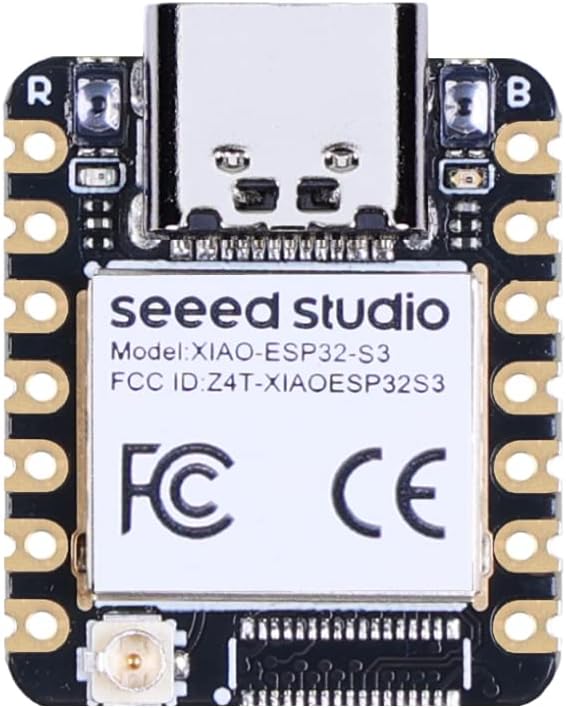
The Seeed Studio XIAO ESP32S3 redefines what a compact development board can achieve with its thumb sized form factor and rich feature set. It is specifically designed for wearable devices and space constrained projects where size and power efficiency matter most.
We may earn a commission when you buy through this link, at no additional cost to you.
Its power design supports lithium battery charging and offers multiple power consumption models including a deep sleep mode that draws as little as 14 microamps. This capability is crucial for battery powered devices that need to run for months without recharging.
Despite its small size it maintains strong RF performance with support for 2.4GHz Wi-Fi and BLE 5.0. You can also connect an external U.FL antenna for extended range which makes it versatile for both indoor smart home and outdoor environmental sensing projects.
We recommend this board for designers building wearable technology or portable IoT gadgets. The combination of power efficiency and wireless connectivity makes it a top choice for projects that prioritize long battery life and compact form factors.
Multiple power modes including deep sleep at 14uA ensure your device remains energy efficient even during extended periods of inactivity.
The tiny footprint and battery management system allow for easy integration into clothing accessories and handheld devices without bulky components.
We may earn a commission when you buy through this link, at no additional cost to you.
This board takes a different approach by utilizing the ESP32-P4 chip with a RISC-V core designed for high performance computing tasks. It includes specialized interfaces like MIPI-CSI and MIPI-DSI which are typically found on more expensive boards for handling image and display data.
We may earn a commission when you buy through this link, at no additional cost to you.
The onboard Ethernet and SDIO TF card slot provide robust options for data transfer and storage which are essential for applications involving video or large datasets. This makes it a unique choice for projects that require more than standard microcontroller capabilities.
Security features like Secure Boot and Flash Encryption add a layer of protection for sensitive applications ensuring that code cannot be easily tampered with. The hardware also supports cryptographic accelerators to speed up encryption tasks without overloading the main processor.
We suggest this board for advanced developers working on vision or audio processing systems. It is particularly useful for those who need fast image handling and secure connectivity in a compact development environment without resorting to full Linux systems.
MIPI-CSI and DSI interfaces allow direct connection to high resolution cameras and displays for advanced visual feedback systems.
Hardware level secure boot and encryption ensure your device integrity and protect sensitive data from unauthorized access or modification.
We may earn a commission when you buy through this link, at no additional cost to you.
Getting three boards in one package makes this offering from Waveshare an excellent value for classrooms or projects requiring multiple nodes. Each board is equipped with the reliable ESP32-S3FH4R2 chip ensuring consistent performance across all units in your development or production run.
We may earn a commission when you buy through this link, at no additional cost to you.
The module design includes castellated edges which allow you to solder the board directly onto a custom carrier for a compact end product. This feature is particularly useful for transitioning from prototyping to manufacturing without needing complex connectors or adapters.
Power management is handled through flexible settings that allow you to adjust clock speeds and independent power supplies to optimize energy use. This can significantly extend battery life in portable applications where efficiency is critical for long term operation.
We recommend this pack for educators or teams needing multiple identical units for testing or distributed sensors. It provides a cost effective way to implement multi node systems without sacrificing the core capabilities of the ESP32-S3 family.
Castellated module edges enable direct soldering onto PCBs for compact and reliable final products without bulky connectors.
Flexible clock and power supply settings allow fine tuning of performance versus energy use for specific application requirements.
We may earn a commission when you buy through this link, at no additional cost to you.
This kit is designed for those just starting their journey into electronics and IoT with everything needed to build over 35 different projects. It centers around a capable ESP-32 board and includes a vast array of sensors motors and displays to explore various functionalities.
We may earn a commission when you buy through this link, at no additional cost to you.
The accompanying tutorial provides clear circuit diagrams and code examples that guide you through each project from start to finish. This hands-on approach helps build a solid understanding of electronics principles without requiring prior experience or complex setup.
While the core board uses an older ESP-32 variant it still offers robust dual-core performance and integrated Wi-Fi and Bluetooth 4.2. For learning purposes this is sufficient to understand the basics of wireless communication and sensor interfacing effectively.
We suggest this kit for students and hobbyists who want a guided learning experience. It is the perfect entry point for mastering electronics concepts and moving towards more advanced custom designs once the basics are understood.
Detailed tutorials and code examples ensure beginners can follow along easily and build confidence with each completed project.
Over 35 modules include sensors and displays allowing for a wide range of projects from simple LED control to complex IoT apps.
We may earn a commission when you buy through this link, at no additional cost to you.
The Nano 33 IoT focuses on security and reliability for connected devices using a secure element that provides hardware level encryption for cloud communication. This is vital for projects where data privacy and integrity are top priorities such as home automation or medical monitoring.
We may earn a commission when you buy through this link, at no additional cost to you.
Powered by the SAMD21 ARM Cortex-M0+ processor it delivers efficient performance for low power applications while maintaining compatibility with the familiar Arduino IDE. The pre-soldered headers make it easy to connect to breadboards and external components immediately out of the box.
Although the processor speed is lower than the ESP32 variants it is sufficient for most IoT tasks that prioritize low energy consumption over heavy computation. Its size and connectivity make it a great fit for discreet sensor nodes in smart environments.
We recommend this board for projects where security is non-negotiable. It provides peace of mind for deploying connected devices that handle sensitive information or require secure cloud authentication without complex software encryption layers.
The ATECC608A secure chip ensures that cloud connections are encrypted at the hardware level preventing unauthorized access to data.
The SAMD21 Cortex-M0+ balances performance and power consumption ideal for battery operated IoT nodes that need to run for long periods.
We may earn a commission when you buy through this link, at no additional cost to you.
This pack of three ESP-WROOM-32 boards offers a classic and reliable entry into the ESP32 ecosystem. It uses the well-documented ESP32-S chipset which has extensive library support and community resources for solving common development challenges.
We may earn a commission when you buy through this link, at no additional cost to you.
Each board supports Access Point Station and mixed modes allowing flexibility in how devices connect to networks. Whether you need to set up a local network or connect to a router the board handles these transitions smoothly for various IoT scenarios.
Power consumption is managed effectively allowing for low power modes suitable for battery operated sensors. While it lacks newer features like USB-C the simple design ensures stability and ease of use for fundamental wireless communication tasks.
We suggest this set for students or makers needing multiple nodes for a network project. It provides a cost-effective way to experiment with distributed sensor networks without compromising on core connectivity performance and stability.
Support for AP STA and mixed modes gives you full control over how your device connects to routers or creates its own network.
The classic ESP32-S chipset ensures compatibility with thousands of open-source libraries and projects for fast development and debugging.
We may earn a commission when you buy through this link, at no additional cost to you.
ELEGOO provides a convenient three-pack of ESP-32 boards featuring USB-C for easier connection and power management. This upgrade simplifies wiring and ensures compatibility with modern cables which is a common pain point with older micro-USB boards.
We may earn a commission when you buy through this link, at no additional cost to you.
The boards support Over-the-Air updates meaning you can deploy new firmware over Wi-Fi without needing to physically reconnect via USB each time. This feature saves significant time during testing and deployment cycles for distributed sensor networks or prototypes.
Power-saving features like dynamic clock scaling allow you to optimize energy use based on current task requirements. While the Bluetooth version is older it remains fully functional for most home automation and simple sensor projects that do not require the latest standards.
We recommend this set for builders who prefer USB-C convenience and bulk efficiency. It is perfect for classroom labs or workshops where multiple users need access to reliable hardware that supports modern connectivity standards.
USB-C ports make power and data transfer faster and easier with reversible plugs that reduce wear on the board over time.
OTA support allows remote firmware updates which streamlines the development process and reduces physical access requirements for deployed devices.
We may earn a commission when you buy through this link, at no additional cost to you.
The UNO R4 WiFi is an advanced evolution of the classic Arduino UNO featuring a dual core setup that combines processing power with native wireless connectivity. It introduces unique features like a built-in LED matrix for visual feedback and CAN bus support for robust industrial communication.
We may earn a commission when you buy through this link, at no additional cost to you.
The inclusion of a high precision 12-bit DAC and operational amplifier makes it suitable for audio projects and applications requiring precise analog signal generation. The Qwiic connector further simplifies wiring by allowing plug-and-play I2C sensor connections without soldering.
While it is larger than Nano style boards it offers a comprehensive suite of features that reduce the need for extra breakout boards in many cases. This makes it a highly efficient choice for complex projects that require both high-end connectivity and analog capabilities.
We suggest this board for professionals and educators needing a versatile platform for advanced projects. It provides a rich ecosystem for students to learn about industrial standards and complex interfaces while enjoying the ease of use of the Arduino IDE.
The 12×8 LED matrix allows you to display text or patterns directly on the board for immediate visual status updates without external screens.
CAN bus support enables reliable communication in noisy environments making it suitable for automotive and industrial control applications.
We may earn a commission when you buy through this link, at no additional cost to you.
Choosing the right board involves balancing processing power wireless features and form factor to match your project needs.
Look for dual-core processors like the ESP32-S3 which offer better multitasking and speed for complex tasks. Ensure the board has enough RAM and Flash to handle your code and data storage requirements efficiently.
Prioritize boards with sufficient RAM for data logging projects to prevent performance bottlenecks during operation.
Modern projects often require the latest Wi-Fi and Bluetooth standards for compatibility with smartphones and smart home systems. Bluetooth 5.0 offers better range and stability than older versions which is crucial for reliable connections.
Check if the board supports both Wi-Fi and Bluetooth to maximize connectivity options for your specific use case.
Battery powered devices need boards that support deep sleep modes and low power states to extend usage time. Features like independent power rails or dynamic clock scaling help minimize energy use when the device is idle.
Always check the power specs if you plan to run your project on batteries for extended periods without frequent recharging.
Consider what physical connections you need such as USB-C for modern power and data transfer. Additional interfaces like MIPI or Ethernet may be required for video or high speed data applications.
USB-C is becoming standard so newer boards with this port will be more convenient for future upgrades and replacements.
If your project is wearable or space constrained a compact board like the XIAO style is ideal. Larger boards offer more pin headers and easier soldering which benefits prototyping and breadboarding.
Match the board size to your enclosure or project layout to ensure the device is portable and easy to install.
Ensure the board works seamlessly with the Arduino IDE or MicroPython to simplify the coding process. Official boards often receive firmware updates and community support more reliably than generic alternatives.
Official support can save time on troubleshooting so prioritize recognized platforms if you are new to development.
Secure elements and encryption capabilities protect your data and prevent unauthorized access to the device. This is important for projects involving personal data or critical infrastructure.
Look for hardware-level encryption features if your project requires high standards for privacy and safety.
Some boards come with headers or connectors like Qwiic to make adding sensors easier without soldering. Others might have castellated edges for direct PCB integration which is useful for custom manufacturing.
Choose a board with the right connectors to streamline your workflow and reduce the need for additional breakout boards.
Start by connecting the board to your computer using a USB cable and installing the necessary drivers. Open your development environment and select the correct board and port to ensure proper communication.
Upload a simple test sketch to verify that the hardware is functioning correctly before starting your main project. This helps confirm that drivers are working and the board is ready for programming.
Avoid exposing the board to excessive heat or moisture to prolong its lifespan and ensure reliable operation. Store unused boards in a dry place and handle them with care to prevent damage to the sensitive pins and components.
The Arduino Nano ESP32 features the newer ESP32-S3 chip with faster processing and support for MicroPython. It also includes built-in USB-C and supports newer Bluetooth standards for better connectivity with modern devices.
Yes many of the boards in this list including the Arduino Nano ESP32 support MicroPython. This allows for easier coding using Python syntax instead of C++ which is helpful for beginners and quick prototyping.
You will need a USB-C cable to connect the board to your computer for power and programming. Most modern laptops and phones use USB-C so finding a compatible cable is usually easy.
Connect the board to power and use the Arduino IDE or MicroPython environment to write code that scans for networks. You will need to enter your SSID and password in the code to establish a secure connection.
Yes many models include power saving features like deep sleep modes to conserve energy. Check the specific board specs for current draw in sleep mode to ensure it meets your battery life requirements.
The secure element provides hardware level encryption to protect your data and code. It ensures that connections to the cloud are secure and prevents unauthorized users from accessing sensitive information.
Yes all of these boards support common interfaces like I2C SPI and UART for connecting sensors. Some also feature Qwiic connectors to simplify wiring for specific compatible modules without soldering.
Consider your needs for size memory and specific features like Ethernet or LED matrices. The official Nano offers stability while third-party options may offer more memory or cost savings for bulk projects.
Whether you choose the official Arduino Nano ESP32 for its robust support or a budget-friendly alternative like the ESP32-S3-Nano each board on this list offers strong capabilities for modern development. The top picks cover a range of needs from compact wearables to secure IoT deployments.
Prioritize factors like processing speed connectivity and form factor when making your decision. Understanding your project requirements early will help you select a board that grows with your ideas and ensures long-term satisfaction with your builds.
Remember to check current availability and pricing before purchasing as these details can change frequently. Selecting the right hardware sets the foundation for success and helps you bring your innovative IoT and embedded projects to life efficiently.