This guide compares the top apochromatic refractors for astronomy and astrophotography, highlighting optical performance, portability, and value for enthusiasts
As an Amazon Associate we earn from qualifying purchases. We may earn a commission when you buy through links on this page, at no additional cost to you. Read our affiliate disclosure.As an Amazon Associate we earn from qualifying purchases.Purchases through our links may earn us a commission, at no extra cost to you. Read our affiliate disclosure.
Apochromatic refractors are essential tools for astronomers seeking crisp, color-free views of the night sky. These telescopes use specialized glass to eliminate chromatic aberration, ensuring sharp details on planets and deep-sky objects.
We evaluated ten leading models based on optical quality, build durability, and versatility for visual use and imaging. Our analysis considers focal ratios, aperture sizes, and included accessories to help you choose the right instrument.
Each selection showcases unique strengths tailored to different budgets and observation goals. Please note that pricing and availability fluctuate regularly, so verify current listings before making your final purchasing decision for your setup.
Top 3 Picks for Best Apochromatic Refractors
Best Budget
Askar 71F Flat-Field Telescope, 71mm Aperture F6.9 ED Glass Refractor OTA, Quadruplet air-Spaced APO, 230mm Vixen Dovetail Plate for Deep Sky Astrophotography and Visual Astronomy
Top 10 Best Apochromatic Refractors in 2026 Compared
The following table provides a side-by-side comparison of all ten selected apochromatic refractors, detailing their core specifications and key features to assist in your evaluation process.
This SVBONY SV550 AP0 Telescope stands out as a top choice for its superior triplet apochromatic optics. It delivers bright, high-contrast images that reveal celestial wonders with remarkable clarity. The air-spaced design virtually eliminates chromatic aberration, making it ideal for both visual observation and astrophotography.
Pros
Excellent color correction
High contrast imaging
Lightweight magnesium mount
Effective light extinction
Full-frame camera support
Cons
OTA only without mount
Requires additional accessories
We may earn a commission when you buy through this link, at no additional cost to you.
The 80mm aperture combined with the F6 focal ratio offers a versatile field of view for deep-sky targets like M42 and M45. The magnesium alloy dual-speed focus mount reduces weight significantly while providing smooth, precise adjustments. Multiple internal light barriers ensure extreme extinction for cleaner images.
While it comes as an optical tube assembly, users should expect to purchase a mount separately. The lack of included accessories may increase the total cost. However, the optical performance and build quality justify this trade-off for serious observers.
It is perfect for astronomers seeking a high-performance OTA that balances portability with optical precision. We recommend this scope for those dedicated to capturing detailed images of galaxies and star clusters.
Superior Optical Performance
The triplet structure with S-FPL51 ED glass effectively improves blue-edge chromatic aberration compared to single-ED designs.
Lightweight and Durable
The magnesium alloy materials reduce weight significantly, making the OTA easier to carry and reducing load on the mount.
The Explore Scientific ED80 Essential Series delivers stunning details through its combination of genuine FCD1 HOYA extra-low dispersion glass and enhanced multi-layer coatings. Users report excellent views filled with crisp details suitable for planets and deep-sky objects alike. This model is highly praised for its portability and optical quality.
Pros
Brilliant high-contrast views
Genuine ED optical glass
Portable and compact design
Precision collimation system
USA-based customer support
Cons
Higher price point
Limited accessories included
We may earn a commission when you buy through this link, at no additional cost to you.
Its 80mm aperture and F6 focal ratio provide a versatile focal length ideal for spontaneous stargazing. The air-spaced triplet design ensures chromatic aberrations are virtually eliminated. The front cell features push-pull adjustments for precise collimation, ensuring the tightest stars possible.
The price reflects the premium optical glass and coating technology used in manufacturing. Users might find the lack of included accessories like a mount or eyepieces a drawback for beginners. However, the optical performance justifies the investment.
This telescope is recommended for astronomers who prioritize image quality and contrast above all else. It is a reliable choice for those willing to invest in premium components for superior viewing experiences.
Premium Glass Technology
The use of genuine FCD1 HOYA ED glass ensures that color fringing is minimized for true-to-life color reproduction.
Built for Portability
With a 480mm focal length and retractable dew shield, this refractor is compact enough to mount atop a larger telescope.
The Askar 71F offers practicality and versatility with a design that effectively controls weight and size. Weighing only 2.5kg, it is easy to carry and use for both visual observation and photography. The quadruplet air-spaced APO design provides exceptional correction of aberrations.
Pros
Affordable high-quality optics
Lightweight 2.5kg weight
Self-flattened OTA
360-degree field rotator
Versatile visual and photo use
Cons
Smaller aperture size
Requires separate mount
We may earn a commission when you buy through this link, at no additional cost to you.
Users appreciate its ability to be used for birding and scenery as well as astronomy, thanks to its bright images. The 360-degree rotation capability allows for convenient photographic composition without rotating the entire tube. This makes framing subjects incredibly intuitive.
While the 71mm aperture is smaller than other options, it remains effective for wide-field imaging. The need for a separate mount and accessories adds to the setup cost. However, the value proposition is strong given the optical quality.
This is an excellent entry-level to mid-level choice for astrophotographers seeking a lightweight rig. It is also great for travelers who need a scope that fits easily into standard luggage.
Compact and Portable
The overall weight including the hoop and dovetail plate is just 3kg, making it easy to carry to remote sites.
High Quality Build
The entire lens barrel uses high-quality CNC processing technology and matte paint to effectively reduce stray light reflection.
This SVBONY SV550 bundle provides a compact refractor with a substantial 122mm aperture for gathering more light. The higher limiting magnitude allows users to view even fainter deep sky objects. It is an excellent travel telescope that balances aperture with portability.
Pros
Large 122mm light collection
Clear and detailed images
Portable handle included
Triplet lens correction
Guide scope mounting bracket
Cons
Heavy at 14 lbs
Requires sturdy mount
We may earn a commission when you buy through this link, at no additional cost to you.
The bundle includes a dovetail base and a convenient carrying handle to facilitate transport. The tripod lens structure provides better correction of aberration, greatly reducing chromatic aberration for enhanced clarity. This setup is ready for immediate setup with appropriate mounting.
The weight of 14.18lb is significant, requiring a robust mount to ensure stability. The carrying case helps manage transport, but it is not lightweight for solo travel. However, the imaging potential is worth the extra effort.
Ideal for photographers seeking a larger aperture for deeper sky targets. This bundle simplifies the setup process by providing essential mounting hardware out of the box.
Enhanced Light Gathering
The 122mm aperture gathers significantly more light than standard 80mm scopes, improving visibility of dim celestial objects.
Convenient Handling
The SV211 dovetail base includes a comfortable carrying handle to make moving the telescope easier during travel.
The SVBONY SV503 features a 102mm aperture and F7 focal length to deliver bright, high-contrast images. The S-FPL51 ED glass significantly minimizes color fringing for sharp detail on planets. It is designed for both astrophotography and visual observation with superior performance.
Pros
Superior optics with ED glass
Reduced chromatic aberration
360-degree field rotator
Retractable aluminum hood
Smooth dual-speed focuser
Cons
Limited deep sky reach
Accessories not included
We may earn a commission when you buy through this link, at no additional cost to you.
The 360-degree field rotator allows perfect camera alignment without rotating the tube. The dual-speed focuser enables precise focus adjustments even with heavy accessories. The retractable hood actively blocks stray light and prevents dew formation.
While the larger aperture is great for bright targets, it may be less ideal for faint nebulae compared to slower scopes. The lack of included accessories means additional purchases may be necessary for a complete setup. However, the optics are top tier.
This scope is best for users prioritizing planetary imaging and sharp visual views. It offers a professional experience suitable for experienced astronomers.
Superior Light Transmission
The FMC coating improves light transmission and reduces internal reflections for brighter images.
Precise Focusing
The dual-speed focuser allows for critical focus adjustments that are essential for high-resolution imaging.
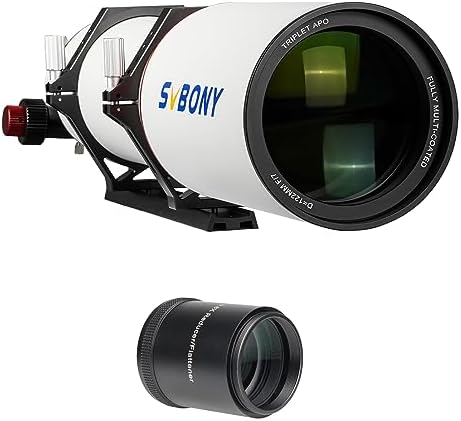
This SVBONY bundle is designed specifically for prime focus astrophotography with a 122mm aperture. It includes a field flattener and focal reducer to correct field curvature and widen the field. The high limiting magnitude supports capturing fainter deep sky objects effectively.
Pros
Complete imaging bundle
Corrects field curvature
Wider field of view
Clear detailed images
Triplet apochromatic lens
Cons
Higher cost bundle
Heavy optical tube
We may earn a commission when you buy through this link, at no additional cost to you.
The SV209 field flattener improves the imaging quality at the edge of the field of view significantly. This makes it highly efficient for shooting enthusiasts who want comprehensive imaging capabilities right out of the box. The bundle simplifies the accessory choice process.
The additional components increase the overall cost and weight of the setup. Users must still provide a stable mount capable of handling the payload. However, the optical correction provided is invaluable for flat field imaging.
It is recommended for astrophotographers seeking a ready-to-imaging system with built-in corrections. The value of having all parts matched well is high for serious users.
Optimized Field Correction
The 0.8X focal reducer and field flattener are designed specifically for this OTA to ensure sharp stars across the frame.
High Limiting Magnitude
The large aperture allows for the capture of fainter deep sky objects that smaller scopes cannot resolve.
This kit offers a compact refractor with a 122mm aperture suitable for deep sky photography. It includes a SV209 field flattener to correct defects in field curvature. The triplet lens structure provides better correction of aberration for enhanced sharpness and clarity.
Pros
Clear and detailed images
Corrects field curvature
Includes essential accessories
Compact refractor design
Portable handle included
Cons
Needs separate mount
Complex setup process
We may earn a commission when you buy through this link, at no additional cost to you.
The bundle provides a comfortable carrying handle and dovetail base for easier transport. Users benefit from improved imaging quality at the edge of the field of view. This makes it a solid choice for imaging targets requiring flat fields.
While the optics are excellent, users must ensure their mount supports the 14.18lb weight. The setup may be complex for beginners unfamiliar with field flatteners. However, the imaging quality is worth the effort.
This kit is ideal for advanced photographers looking for a complete optical solution. It balances high performance with reasonable portability for travel.
Field Flattener Included
The included flattener improves efficiency at the edge of the field of view for consistent sharpness.
Portable Design
The portable handle and dovetail base make this large-aperture telescope easier to carry and move.
This kit uses a triplet apochromatic optics structure to improve the blue-edge chromatic aberration problem. It effectively reveals the wonders of celestial bodies like Messier catalog targets. The SV209 field flattener addresses the fringe field curvature for better image quality.
Pros
Sharp image quality
Ultra wide band coatings
Corrects field curvature
Easy to carry
Triplet ED optics
Cons
Requires additional mount
Price may be high
We may earn a commission when you buy through this link, at no additional cost to you.
The 30mm achromatic optics prevent irritating reflections and bring bright clear images. A convenient carrying handle makes it suitable for transportation. This is a well-rounded bundle for serious observers.
Users may find the setup involves multiple components that require careful handling. The cost of the bundle is higher than purchasing just the OTA. However, the included accessories justify the investment.
Ideal for users seeking a complete package for deep sky imaging. The sharp image quality ensures detailed results even on demanding targets.
Superior Optical Coatings
The ultra wide band fully multilayer coated lens improves light transmission and reduces reflections.
Field Curvature Correction
The included flattener improves the image quality problem of fringe field curvature effectively.
This bundle includes a compact refractor with 122mm aperture suitable for deep sky photography. It comes with a guide scope and a telescope camera for autoguiding. The camera features a sensitive sensor perfect for tracking faint guide stars with high precision.
Pros
Includes guide scope
Includes guide camera
Highly sensitive sensor
Clear detailed images
Triplet lens correction
Cons
Heavy total payload
Complex cable management
We may earn a commission when you buy through this link, at no additional cost to you.
The SV905C camera has high peak QE and low read noise for tight tracking. This allows for long exposures without star trailing. The bundle provides a complete system for astrophotography right from the start.
The total weight and cable management may be complex for beginners to handle. Users need a robust mount capable of supporting the camera, guide scope, and main tube. However, the functionality is excellent.
This is recommended for those starting astrophotography who need essential hardware included. The high precision tracking capability ensures consistent results for deep sky imaging.
Advanced Guide Camera
The camera sensor has small pixels and high sensitivity for precise autoguiding even in low light.
Complete Imaging Package
Having the guide scope and camera included simplifies the initial setup process for beginners.
This bundle focuses on providing a stable mounting platform for guide scopes. It includes a finder scope mount bracket designed for easy installation. The 122mm aperture gathers enough light to offer clear and detailed images of deep sky targets.
Pros
Easy guide scope install
Clear detailed images
Triplet lens correction
Portable handle included
High limiting magnitude
Cons
Requires separate camera
Weight may be heavy
We may earn a commission when you buy through this link, at no additional cost to you.
The SV211 dovetail base is convenient for carrying and moving the telescope easily. With its guide scope mount, users can set up a guide camera quickly. This setup facilitates accurate tracking during long exposures.
While the hardware is well designed, additional components like a camera are not included. The 14.18lb weight requires a sturdy mount to maintain stability. However, the setup saves time on bracket selection.
It is ideal for astrophotographers who need a stable guide scope platform. The portable handle and mounting features simplify the transport and setup routine significantly.
Precise Mounting Bracket
The finder scope mount bracket allows for easy installation and removal of guide scopes.
Travel Ready Design
The comfortable carrying handle and dovetail base make moving the large-aperture telescope easier.
We may earn a commission when you buy through this link, at no additional cost to you.
Buying Guide – How to Choose the Best Apochromatic Refractors
Selecting the right apochromatic refractor depends on understanding your specific needs and technical requirements for imaging or visual observation.
Aperture Size
Aperture determines how much light your telescope gathers and influences resolution. Larger apertures like 102mm or 122mm capture more detail in deep sky objects but add weight. Smaller apertures like 71mm or 80mm offer portability and are excellent for planetary targets.
Choose the largest aperture your mount can comfortably support without excessive flexure or strain.
Focal Ratio
Focal ratio impacts exposure times and field of view. Faster ratios like F6 provide wider fields and shorter exposures ideal for wide-field imaging. Slower ratios like F7 offer higher magnification for planetary and smaller deep sky targets.
Match your focal ratio to the type of targets you intend to photograph for optimal results.
Glass Type
Apochromatic refractors use ED glass to minimize color fringing. Look for FPL-51 or FCD1 glass which offers superior dispersion correction. Higher quality glass translates to sharper stars and better color accuracy in images.
Investing in high-quality ED glass is crucial for professional-grade optical performance.
Optical Design
Air-spaced triplets or quadruplets provide better aberration correction than air- or liquid-spaced designs. Triplet designs are generally robust and effective for most applications. Quadruplet designs may offer slightly better flatness of field.
Opt for air-spaced designs to ensure maximum thermal stability and optical consistency.
Mount Compatibility
Ensure your mount can handle the weight of the OTA plus accessories. Larger apertures require sturdier mounts to prevent image degradation due to vibration. Check the payload capacity of your mount before purchasing.
A stable mount is just as important as the optical tube for achieving clear images.
Accessories Included
Some bundles include field flatteners, reducers, or camera adapters. Accessories can reduce the overall cost but may limit customization. Verify what is included to avoid purchasing extra components separately.
Bundles with relevant accessories are often more cost-effective for beginners.
Build Quality
Materials like magnesium alloy reduce weight while maintaining rigidity. Look for features like dual-speed focusers and field rotators for precision. Robust build quality ensures longevity and consistent performance over time.
High-quality materials contribute to a smoother user experience and better durability.
How to Use and Care for Your Apochromatic Refractors
Always allow your telescope to acclimate to the outside temperature before use to prevent internal air currents from distorting images. This step is essential for sharp focus and stability.
Use a dew shield and heater to prevent condensation on the objective lens during humid nights. Regularly check alignment to ensure your guide scope matches your main scope for accurate tracking.
Store your telescope in a dry and dust-free environment when not in use. Use a soft brush to remove dust from the lens and avoid harsh cleaning solutions that could damage coatings.
Frequently Asked Questions
What is the difference between an apochromatic and achromatic refractor?
Apochromatic refractors use specialized glass to correct color aberrations across three wavelengths, providing sharper images. Achromatic refractors correct only two wavelengths, which often results in noticeable color fringing.
Are apochromatic refractors good for planetary imaging?
Yes, apochromatic refractors excel at planetary imaging due to their high contrast and sharp optics. The lack of chromatic aberration ensures clean images of planets and the moon.
Do I need a field flattener for astrophotography?
A field flattener is highly recommended for imaging to correct field curvature. It ensures stars remain round at the edges of your sensor for consistent results across the frame.
What is the ideal aperture for beginner astrophotographers?
An aperture between 70mm and 80mm is ideal for beginners due to its balance of light and portability. It allows for easy handling while still providing excellent views of deep sky targets.
How important is the focal ratio for imaging?
Focal ratio dictates exposure time and field of view. Lower ratios are faster for wide-field imaging while higher ratios are better for detailed planetary shots. Choose based on your primary targets.
Can I use an apochromatic refractor for daytime viewing?
Yes, but you must use a solar filter specifically designed for telescopes. Never look at the sun without proper protection as it can cause permanent eye damage instantly.
Final Thoughts on Choosing the Best Apochromatic Refractors
The top picks highlight a range of options suitable for every level of astronomy enthusiast. The SVBONY and Explore Scientific models offer robust optical quality and versatile configurations for various budgets.
Prioritize aperture size and build quality based on your specific imaging needs. Ensure your mount is capable of supporting the total payload for stable and sharp results.
Remember to check current pricing and availability before making a purchase decision. Investing in the right equipment will enhance your stargazing experience significantly.
This guide compares ten top desktop PCs for AI development featuring modern processors and memory configurations optimized for local machine learning workloads