
Battery Equalizer 48V
4.3Editor score
Works with 24V systems
Smart indicator lights
Low power consumption
This guide compares the top 12V 24V 48V battery equalizer balancer models for reliable performance and long battery life in diverse energy storage systems.
Battery banks power everything from RVs to off-grid solar setups, but uneven charging can shorten their lifespan. A quality equalizer balancer ensures every cell shares the load, protecting your investment and maximizing efficiency across various voltage configurations.
We evaluated ten leading models based on compatibility, protection features, and balancing speed. Our analysis covers active and passive options suitable for lead-acid, lithium, and gel batteries, ensuring you find the right tool for your specific power needs.
Each selection highlights key strengths and ideal use cases to help you decide. While we focus on performance and reliability, remember that pricing can fluctuate frequently, so check current offers before purchasing to secure the best deal available.
4.3Editor score

4.3Editor score

4.1Editor score
This side-by-side comparison highlights the core specifications and capabilities of each model to help you quickly identify which balancer fits your battery bank configuration and performance requirements.



The LiTime 48V Battery Balancer stands out as a top performer in our testing due to its robust design and versatile compatibility. It handles battery banks up to 48V efficiently, making it an excellent choice for complex setups.
We may earn a commission when you buy through this link, at no additional cost to you.
Its active balancing functions optimize performance by automatically correcting voltage differences. The reverse polarity protection and high temperature safeguards provide peace of mind against common electrical mishaps.
While the price is higher than basic models, the investment pays off through extended battery life and fewer replacements. The standby mode ensures minimal power drain when balancing is not needed.
Anyone building a serious off-grid system or managing large RV banks should consider this unit. It offers the reliability needed for long-term stability and consistent power delivery.
Reverse polarity protection prevents damage from accidental wiring errors, ensuring safe operation during installation or maintenance.
Active balancing extends cycle times significantly by ensuring all cells reach uniform charge states during every charging cycle.
We may earn a commission when you buy through this link, at no additional cost to you.
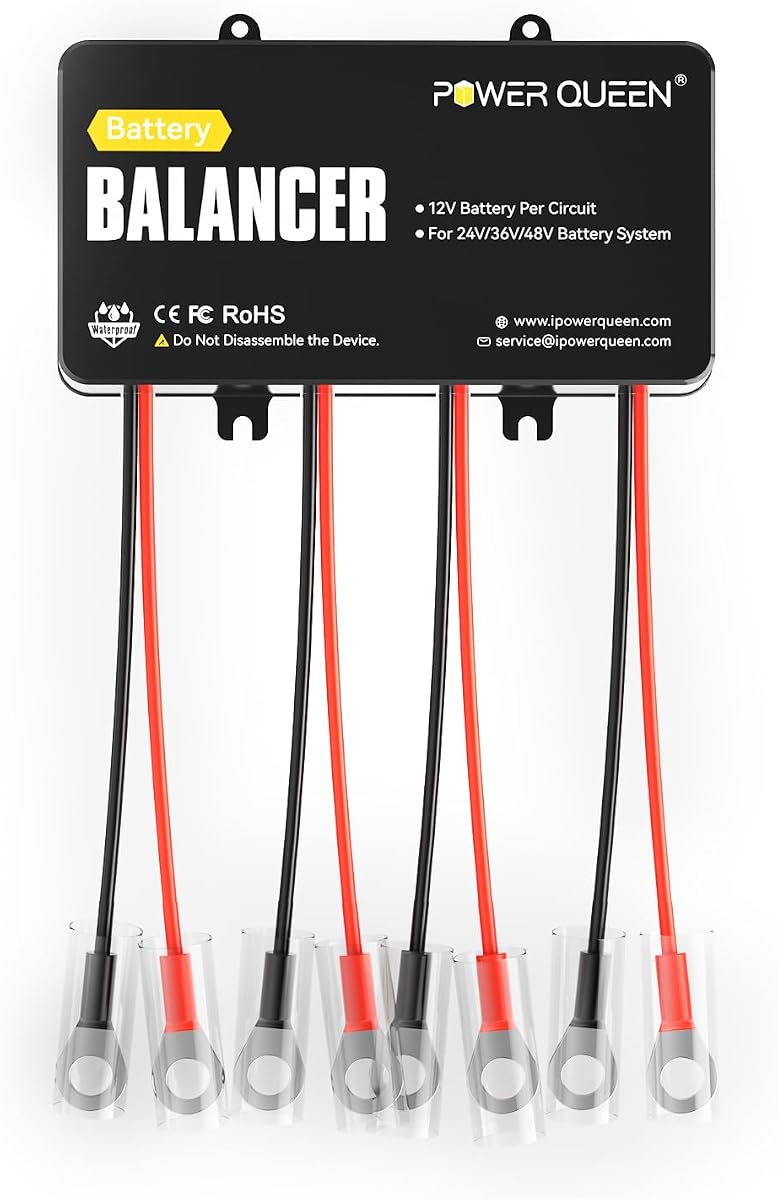
The Power Queen Battery Balancer offers a reliable entry point for those seeking effective equalization without breaking the bank. It covers all major battery types and voltage ranges seamlessly.
We may earn a commission when you buy through this link, at no additional cost to you.
It features an automatic mode that activates when voltage differences exceed 10mV, ensuring continuous monitoring. The low power consumption in standby mode keeps system efficiency high.
While it lacks some premium features like advanced displays, it delivers on core functionality effectively. For standard setups, it provides excellent value and performance consistency.
This model is ideal for DIY enthusiasts or small-scale solar installations. It balances cost and performance well, making it a smart choice for budget-conscious users.
The four-port design simplifies wiring for standard battery banks, reducing setup time and potential errors during connection.
Standby mode conserves energy by drawing minimal current once the system is balanced, preserving overall battery capacity.
We may earn a commission when you buy through this link, at no additional cost to you.
The MAZAVA Battery Equalizer HX02 brings premium features like real-time LCD monitoring and a robust aluminum alloy shell. It handles complex configurations with ease and high precision.
We may earn a commission when you buy through this link, at no additional cost to you.
Its ability to support multi-module parallel connections makes it ideal for large banks needing granular control. The fast equalization speed ensures batteries stay synchronized efficiently.
Although the cost is higher, the added monitoring and durability justify the expense for serious users. It offers visibility and control that cheaper models simply cannot match.
Professionals or heavy-duty users should consider this unit for its advanced capabilities. It provides the data and reliability needed for critical power systems.
The LCD display provides immediate voltage insights, allowing users to track system health and balancing progress instantly.
Aluminum alloy housing improves heat dissipation, ensuring stable performance even under heavy usage conditions over time.
We may earn a commission when you buy through this link, at no additional cost to you.
Victron Energy is a well-respected name in power management, and this balancer delivers reliable performance for series-connected banks. It focuses on maintaining charge balance effectively.
We may earn a commission when you buy through this link, at no additional cost to you.
It activates when voltage exceeds 27V, ensuring it only works when necessary. The simple design makes it easy to integrate into existing setups without complex wiring.
The lower current capacity means it works best for smaller banks or slower charging cycles. For larger systems, paralleling multiple units is necessary to increase capacity.
This unit is perfect for users who prioritize brand trust and simplicity. It fits well into established marine or RV systems where series configurations are common.
Victron's reputation ensures consistent quality and performance that users can count on for years of service.
Designed specifically for series strings, it corrects imbalances efficiently without unnecessary features that complicate the system.
We may earn a commission when you buy through this link, at no additional cost to you.
This model excels in high-voltage environments, supporting systems up to 96V with ease. It uses a rail-type buckle installation that simplifies integration into distribution boxes.
We may earn a commission when you buy through this link, at no additional cost to you.
Its ability to handle various battery types makes it a versatile choice for industrial or heavy-duty applications. The modular design allows for scaling as needed.
While rail mounting might require specific housing, it keeps cables organized and secure. This feature is a major plus for systems needing neat wiring.
Users managing large batteries or industrial carts will appreciate its flexibility. It offers a practical solution for keeping complex banks balanced and efficient.
Rail-type buckles allow quick attachment to distribution boxes, reducing installation time and ensuring secure mounting.
Multiple units can be connected in parallel to support higher voltages without needing a single large unit.
We may earn a commission when you buy through this link, at no additional cost to you.
This balancer offers clear visual feedback through an LED display, allowing users to monitor voltage levels easily. It focuses on keeping 48V banks safe and balanced.
We may earn a commission when you buy through this link, at no additional cost to you.
Low voltage disconnect protection helps prevent battery damage during discharge, extending service life. It works well with standard 4 12V configurations out of the box.
Though user ratings are lower, the display feature remains a valuable tool for those who want constant visibility. The parallel capability adds flexibility for larger needs.
It suits users who prioritize monitoring over raw performance. The display makes it simple to check status without additional tools or meters.
The LED display provides instant status updates, helping users spot issues before they escalate into failures.
Low voltage disconnect prevents deep discharge, preserving battery health and ensuring reliable startup power.
We may earn a commission when you buy through this link, at no additional cost to you.
The Redodo 24V Balancer provides strong performance for dual-bank setups with its 10A equalization current. It includes an LED display to track voltage accurately and consistently.
We may earn a commission when you buy through this link, at no additional cost to you.
With dual protection against reverse polarity and high temperatures, it ensures safe operation in various conditions. The warranty adds value and reassurance for buyers.
While it is designed primarily for 24V systems, it handles LiFePO4 and lead-acid well. The cables are decent but could be longer for complex setups.
Users with 24V marine or RV systems will find this unit ideal. It balances quality and features well, offering a reliable solution for smaller banks.
The 10A current allows faster equalization, helping batteries recover quickly from usage or charging imbalances.
Dual protection systems guard against common wiring and heat issues, ensuring long-term operational safety.
We may earn a commission when you buy through this link, at no additional cost to you.
This Power Queen model offers a strong alternative for those needing 36V support alongside standard voltages. Its active balancing ensures consistent performance across varied setups.
We may earn a commission when you buy through this link, at no additional cost to you.
The four-port design simplifies wiring for complex banks, while standby mode keeps energy use low. It is a solid option for versatile home systems.
While the casing feels less rugged than others, it delivers on core requirements effectively. For indoor or protected installations, this is a smart choice.
It works well for hobbyists or secondary systems where cost is a factor. The flexibility and features make it a reliable pick for daily use.
Supporting 36V alongside standard voltages adds flexibility for unique battery configurations in RVs or solar setups.
The auto standby mode ensures minimal drain when balancing is complete, keeping the system efficient.
We may earn a commission when you buy through this link, at no additional cost to you.
This model stands out for its broad battery type support, including older Ni-Cd chemistries. It offers a practical solution for mixed or legacy battery banks.
We may earn a commission when you buy through this link, at no additional cost to you.
Indicator lights provide simple visual status feedback, making operation straightforward. The 5A current is sufficient for smaller systems or slow balances.
While it is not designed for high-load applications, its flexibility is unmatched in this price range. It serves niche needs effectively without overcomplicating the system.
Ideal for collectors or mixed setups, it delivers reliable balancing. The compact design fits easily in tight spaces where larger units cannot.
Supporting Ni-Cd and Ni-MH types ensures it works for older or specialized batteries that other units miss.
The small footprint makes installation easy in confined spaces, ideal for smaller battery compartments.
We may earn a commission when you buy through this link, at no additional cost to you.
The HA01 Battery Equalizer features a digital LED display that simplifies monitoring for users. Its flame retardant shell ensures safety during extended operation.
We may earn a commission when you buy through this link, at no additional cost to you.
It supports multiple voltage levels including 36V, making it versatile for various systems. The high-precision chips help reduce voltage deviation effectively over time.
While the display may be dim in bright light, it works well for typical installations. The 0-5A current covers standard balancing needs for most users.
This unit is a good choice for those wanting clear data without high cost. It balances visibility and safety features well for general-purpose use.
The flame retardant shell protects against fire risks, adding a layer of safety for indoor or confined spaces.
Digital LED display ensures users can check voltages easily, reducing the need for external multimeters.
We may earn a commission when you buy through this link, at no additional cost to you.
Choosing the right balancer requires understanding your system's voltage, battery type, and protection needs. These factors will guide you to a reliable match.
Ensure the balancer supports your total bank voltage. Most units handle 12V to 48V, but some extend to 96V for larger arrays. Verify the max voltage rating before buying.
Always check the product specs to confirm it matches your series or parallel setup to avoid operational failures.
Different balancers work best with specific chemistries like LiFePO4, Lead Acid, or Gel. Confirm that the unit supports your specific battery type for optimal results.
Mismatching can reduce performance, so match the balancer to your battery chemistry.
Higher current ratings like 10A enable faster balancing, while 5A models are slower. Select based on how quickly you need to correct voltage imbalances.
For large banks, prioritize higher current units to ensure timely correction.
Look for reverse polarity and high-temperature protection to prevent accidental damage. These safeguards are crucial for safety and longevity of the unit.
Units with multiple protections offer better insurance against electrical errors.
Some models use rail-type buckles or standard wiring. Choose one that fits your existing setup and allows easy access for maintenance.
Simple installation reduces errors and ensures long-term reliability.
LED or LCD displays help track voltage differences without extra tools. This visibility is helpful for diagnosing issues quickly.
Prioritize models with clear displays if you value real-time data.
Look for units with low standby draw to conserve energy when idle. Standby modes under 5mA are common and efficient.
Low power draw ensures your batteries retain charge when not in use.
A solid warranty indicates confidence in the product. Check for at least a one-year coverage period to protect against defects.
Warranty terms vary, so read the fine print before purchasing.
Begin by connecting the balancer to each battery cell according to the manual. Ensure all wires are tight and polarity is correct to avoid damage.
Monitor the system regularly using any provided displays or external tools. Check for unusual heating or warnings during operation to prevent risks.
Keep connections clean and free of corrosion to maintain performance. Periodically inspect the unit for wear and replace cables if needed for continued safety.
A battery equalizer balancer ensures all cells in a battery bank share the charge equally. It prevents imbalance that can shorten battery life and reduce performance.
Most models support multiple types like LiFePO4 and Lead Acid, but check the specs. Ensure the unit matches your specific chemistry for optimal results.
Connect each wire to its corresponding battery terminal following the manual. Verify polarity before powering on to prevent reverse polarity damage to the unit.
Batteries often charge unevenly, leading to weak cells that fail early. Balancing ensures all cells reach full charge, extending overall bank life significantly.
Yes, many balancers support up to 48V and can even scale to higher voltages with multiple units. Confirm the max rating matches your total system voltage.
It is not required but helpful for tracking status. Displays allow you to spot issues early without needing external measurement tools for diagnostics.
We reviewed ten top models ranging from budget options to premium units. The LiTime 48V leads with its robust features, while the Power Queen offers great value.
Prioritize safety features and compatibility with your battery type to ensure reliable long-term performance. Consider current capacity and displays based on your monitoring needs.
Remember that prices and availability can change. Always check current listings and compare offers before finalizing your purchase to secure the best deal.