
HiLetgo 3pcs ESP8266 ESP-01
4.2Editor score
3-Pack for multi-project deployment
Supports AP, STA, and AP+STA modes
Compact wireless transceiver for Arduino
This guide compares the top Arduino WiFi modules for reliable connectivity, speed, and ease of use in your next IoT or embedded design project.
Selecting the right Arduino WiFi module is crucial for any Internet of Things project requiring wireless connectivity. Whether you need simple sensor data transmission or complex smart home automation, the chosen hardware defines performance reliability. Modern modules offer integrated Bluetooth dual dual-core processing to handle demanding tasks efficiently.
We analyzed ten popular WiFi solutions based on technical specifications, community support, and real-world usability. Our comparison covers everything from compact transceiver chips to full-featured boards with USB-C and LED matrices. Each entry reflects current availability and user feedback to help you make an informed choice.
Every pick highlights key strengths and ideal use cases to match your specific project requirements. While prices fluctuate due to market demand, these selections represent the best value and performance available today. Always verify current availability and pricing before finalizing your purchase for your next build.
4.2Editor score

4.7Editor score

4.7Editor score
The following table provides a side-by-side comparison of all ten selected Arduino WiFi modules. It highlights core specifications, connectivity options, and key features to help you quickly identify the best fit for your specific embedded design requirements.



The Arduino UNO R4 WiFi stands out as the premier choice for developers needing robust wireless capabilities. It features a dual-core architecture combining the Renesas RA4M1 for general control and the ESP32-S3 for wireless tasks. This ensures smooth performance without bottlenecks.
We may earn a commission when you buy through this link, at no additional cost to you.
Its connectivity options are extensive, supporting both Wi-Fi and Bluetooth 5.0 for seamless integration into smart home ecosystems. The integrated 12×8 LED matrix allows for immediate visual feedback on the board itself. Additionally, the 12-bit DAC and OP AMP support high-precision analog signal generation.
While the price is higher than basic transceivers, the added features justify the cost for complex projects. The USB-C port simplifies power and data transfer. It also supports CAN bus, making it suitable for automotive or industrial robotics applications.
This board is ideal for makers moving beyond simple sketches to professional IoT deployments. It offers a unified solution for processing, control, and connectivity. For anyone needing a powerful all-in-one Arduino board with wireless, this is the top recommendation.
Separating control and wireless processing ensures that your main loop never gets blocked by network tasks.
The 12-bit DAC and OP AMP enable high-quality audio and sensor signal processing directly on the board.
We may earn a commission when you buy through this link, at no additional cost to you.
The HiLetgo 3-pack of ESP8266 ESP-01 modules offers incredible value for hobbyists building multiple devices. These modules are compact and powerful enough to handle basic IoT tasks efficiently. They are perfect for testing concepts or deploying across a fleet of sensors.
We may earn a commission when you buy through this link, at no additional cost to you.
Each module supports AP, STA, and AP+STA modes, allowing flexible networking configurations. This flexibility is essential for remote monitoring setups or simple smart home devices. The on-board processing capabilities ensure that data handling remains smooth during transmission.
Users must ensure stable 3.3V power delivery, as these modules draw significant current during WiFi transmission. Proper decoupling capacitors are recommended for reliable operation. Despite the need for attention to power, the price makes them highly accessible.
For anyone needing reliable wireless on a budget, this 3-pack is a great starting point. It allows you to experiment without worrying about running out of modules. These are ideal for student projects or small-scale commercial deployments where cost matters.
You can set the module as a standalone access point or connect it to an existing router effortlessly.
The small size ensures it fits easily into tight spaces within your custom electronics enclosures.
We may earn a commission when you buy through this link, at no additional cost to you.
The ELEGOO 3PCS ESP-32 Dev Boards bring high-end performance to hobbyist projects. They feature the ESP-WROOM-32 module which offers dual-core processing power up to 240 MHz. This allows for complex tasks like sensor fusion and wireless communication to run simultaneously.
We may earn a commission when you buy through this link, at no additional cost to you.
These boards support both Wi-Fi and Bluetooth 4.2. This combination is vital for smart home hubs that need to talk to legacy devices and modern smartphones. The USB-C interface ensures reliable connections for uploading code and powering the board.
Power management features are robust, making these boards suitable for battery-operated IoT devices. They support dynamic clock scaling and low-power modes to extend battery life. This is particularly useful for remote environmental sensors that run for months on a single charge.
Developers looking for high speed and connectivity will find these boards unmatched in this price range. The 3-pack provides ample hardware for prototyping and final deployment. It is an excellent choice for advanced makers needing serious computing power.
The dual-core processor handles heavy calculations and network stacks without slowing down your main application.
Having both Wi-Fi and Bluetooth allows you to choose the best connection method for your specific project needs.
We may earn a commission when you buy through this link, at no additional cost to you.
This ESP8266 ESP-01S module distinguishes itself with 4MB of flash memory. This extra storage allows for storing larger code libraries or data logs directly on the module. It is a significant upgrade over standard modules with limited memory.
We may earn a commission when you buy through this link, at no additional cost to you.
The ESP-01S version provides stronger signal strength compared to older versions. This makes it more reliable for projects where the WiFi router is not immediately adjacent to the device. It ensures stable connections even in moderately noisy environments.
Programmers should select the Generic ESP8266 Module board option in Arduino IDE for compatibility. This setup is straightforward and well-documented in community forums. The serial transceiver design allows easy connection to microcontrollers via TX and RX pins.
For projects needing substantial on-board storage or better reception, this module is a solid choice. It balances cost and performance effectively. It is particularly useful for devices that need to cache data locally before syncing with a server.
The 4MB flash allows for more complex sketches and local data buffering without external memory chips.
Enhanced RF design means you can place devices further away from your main router without signal drops.
We may earn a commission when you buy through this link, at no additional cost to you.
The Aitrip 5-pack of ESP8266 ESP-01 modules is designed for bulk prototyping needs. It offers a practical quantity for developing multiple sensor nodes or testing different circuit configurations. This avoids the hassle of running out mid-project.
We may earn a commission when you buy through this link, at no additional cost to you.
Each module supports a voltage range of 3.0V to 3.6V. This flexibility allows operation from various battery types or regulated power sources. The 1MB SPI flash provides standard storage for typical firmware uploads.
Support for AT+Commands simplifies testing without needing a full microcontroller in the loop. You can configure the module directly using a serial terminal. This is helpful for initial setup and diagnostics during development.
For teams or individuals managing several projects at once, this pack is highly efficient. The low cost per unit makes it easy to discard or repurpose modules freely. It remains a staple for cost-sensitive wireless sensor networks.
Buying five units at once ensures you have spares for every stage of your development and deployment.
Direct command interface allows quick configuration testing without complex code upload cycles.
We may earn a commission when you buy through this link, at no additional cost to you.
The Arduino Nano ESP32 brings the power of the ESP32-S3 to a compact Nano-sized board. It is specifically designed for advanced connectivity and custom input applications. Its compatibility with MicroPython makes it accessible for Python developers.
We may earn a commission when you buy through this link, at no additional cost to you.
One of its standout features is Human Interface Device (HID) support. This enables the board to function as a custom keyboard, mouse, or game controller directly over USB. It opens up possibilities for unique interactive projects.
The USB-C port ensures a reliable connection and modern standard integration. Without headers, it is ideal for temporary setups or prototyping breadboards. For permanent builds, soldering headers is necessary to secure connections effectively.
This board is perfect for users who want to move beyond C++ in embedded systems. It is also great for creating specialized input devices. The combination of size, speed, and Python support makes it a unique option in the Arduino lineup.
Python-based programming lowers the barrier to entry for complex scripting and logic implementation.
HID support allows the board to act as a standard peripheral without additional drivers on host computers.
We may earn a commission when you buy through this link, at no additional cost to you.
This 4-pack of ESP8266 ESP-01S modules focuses on reliable RF performance. Each module is designed with self-calibrated RF components to ensure consistent connectivity. This is beneficial for devices that need to operate continuously without disconnection.
We may earn a commission when you buy through this link, at no additional cost to you.
The materials used are reusable, suggesting durability for prototyping and reuse. This reduces waste and cost over time as you iterate on designs. It supports scenarios like home automation and sensor networks where reliability is key.
The modules are suitable for wearable electronics and location sensing devices. Their small form factor allows them to be integrated into tight spaces comfortably. Wireless location sensing benefits from the efficient power usage and signal strength.
For developers needing consistent RF quality, this pack is a solid choice. It balances performance with usability. It is recommended for projects where the module might be moved or reused multiple times during development.
Calibrated RF components mean better signal stability across different environments and temperatures.
High-quality materials allow the modules to withstand multiple projects and testing phases.
We may earn a commission when you buy through this link, at no additional cost to you.
This 5-pack of ESP8266 ESP-01S modules offers a standard configuration for IoT development. The 4MB Flash memory provides plenty of space for most firmware requirements. It is a reliable solution for general purpose Internet of Things applications.
We may earn a commission when you buy through this link, at no additional cost to you.
Users must ensure their power supply is strictly 3.3V. This module does not support 5V directly, so voltage regulation is mandatory. The DOUT protocol requires choosing SPI MODE as DOUT when programming to ensure compatibility.
The standard ESP8266 setup is compatible with common Arduino IDE board settings. This simplicity makes it easy to integrate into existing workflows. The 5-unit pack is perfect for teams or educational environments needing multiple units.
For standard IoT needs, this pack delivers consistent performance. The 4MB storage is a notable upgrade from 1MB variants. It is a smart choice for developers prioritizing memory capacity in compact wireless modules.
The 4MB flash allows for larger firmware images and more complex application logic.
Well-documented and easy to setup for most standard Arduino and ESP32 environments.
We may earn a commission when you buy through this link, at no additional cost to you.
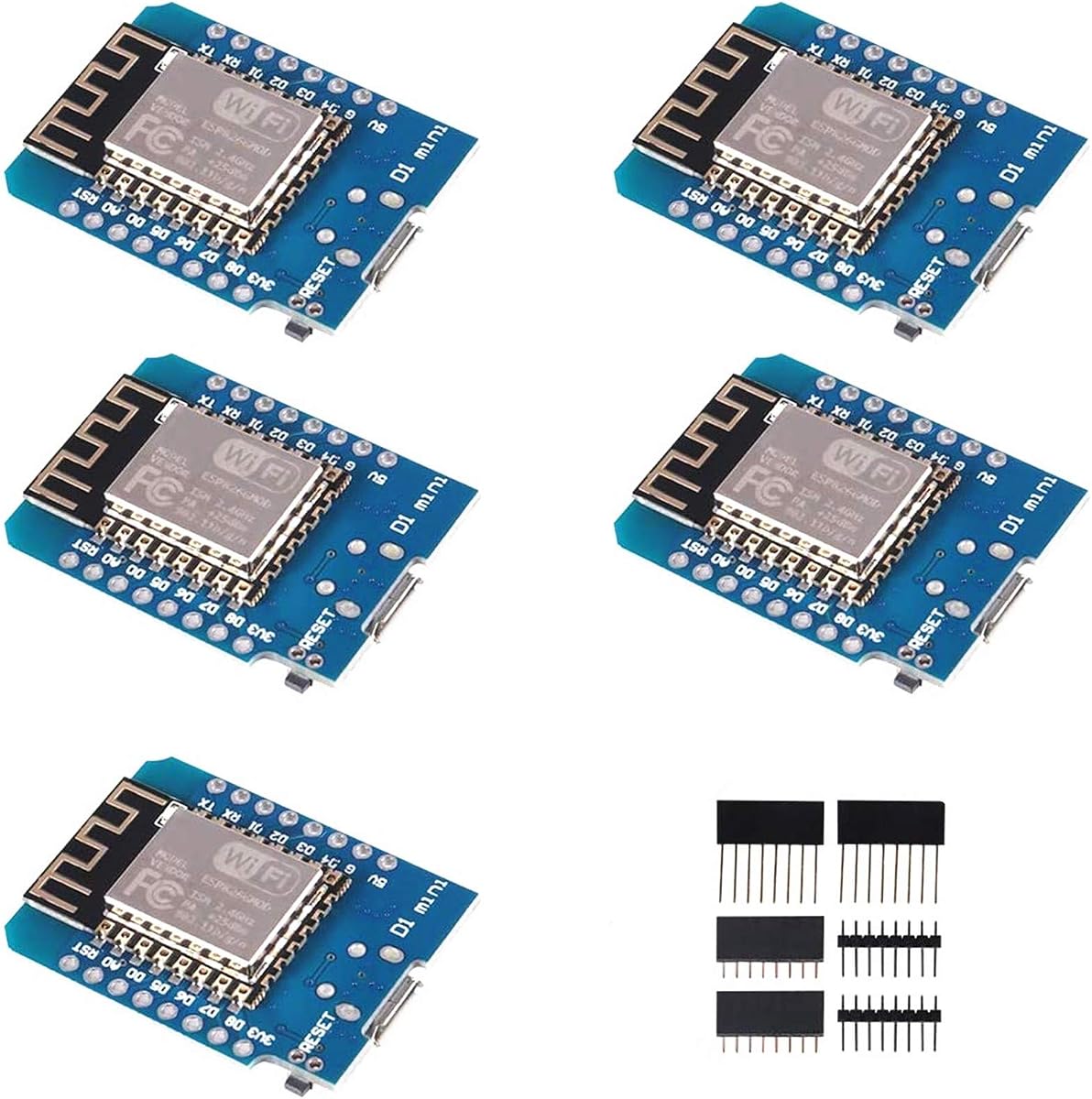
This pack features the D1 Mini based on ESP-12F. It is a popular mini NodeMcu Lua WiFi board designed for compact projects. It offers 11 digital input/output pins with interrupt and PWM support for flexible hardware interfacing.
We may earn a commission when you buy through this link, at no additional cost to you.
The board supports I2C and 1 analog input up to 3.2V. It uses a Micro USB connection which is common for development. The onboard 4M Bytes storage is ample for most Lua and Arduino sketches.
A 500mA resettable fuse protects the board from accidental shorts. The onboard switching power supply makes it robust for 5V USB power sources. It is compatible with Arduino IDE for seamless programming workflow.
Ideal for space-constrained designs, this mini board provides full wireless capabilities in a tiny footprint. It is great for wearables and small sensors. The 5-pack ensures you have enough units for multi-node network testing.
The D1 Mini size allows it to fit into enclosures that standard boards cannot accommodate.
Integrated fuse and regulator protect your device against electrical mishaps during testing.
We may earn a commission when you buy through this link, at no additional cost to you.
This 10-pack of ESP8266 ESP-01 Serial WiFi modules is ideal for large-scale projects. It provides a substantial quantity for deploying entire networks of sensors or devices. The modules offer robust processing capabilities for efficient execution of complex tasks.
We may earn a commission when you buy through this link, at no additional cost to you.
They include ample on-board storage for seamless data retention and retrieval. This is crucial for devices that need to log data locally. The flexibility to operate in AP, STA, or AP+STA modes ensures versatile networking options.
Arduino synergy allows these to be integrated into existing ecosystems easily. The compact yet potent solution is ready for immediate deployment. This bulk order simplifies logistics for large batches or classroom supplies.
For developers managing multiple clients or complex deployments, this pack is the most economical choice. It offers high value and performance consistency. It is a practical solution for those needing quantity without sacrificing quality.
With ten units you can scale your network significantly without needing multiple orders.
Ample on-board storage ensures uninterrupted operation and local data caching.
We may earn a commission when you buy through this link, at no additional cost to you.
Choosing the right WiFi module involves balancing performance, connectivity options, and ease of integration.
The processing power determines how much data you can handle before sending it. Boards with dual-core processors like the ESP32-S3 handle complex logic and WiFi simultaneously.
Look for processors running above 200 MHz for demanding tasks.
WiFi range varies by antenna design and environmental interference. Modules with stronger RF designs maintain better connections in noisy areas.
Check for modules with external antennas if range is critical.
Most WiFi modules operate at 3.3V. Ensure your power supply can handle the current spikes during transmission.
Choose boards with integrated regulators for stable operation.
Flash memory stores your firmware. Larger storage like 4MB allows for more complex libraries and features.
Prioritize 4MB options if using large image or data sets.
Consider how small the module needs to be for your enclosure. Mini boards like D1 Mini save space compared to standard Uno sizes.
Select mini form factors for wearable or tight projects.
USB-C is becoming the standard for new boards. It simplifies power and data transfer.
Opt for USB-C for modern and durable connections.
Some boards support Python via MicroPython while others are C++ only. Check community support for your preferred language.
Ensure compatibility with Arduino IDE for easy setup.
Bluetooth allows direct communication with smartphones. Look for BLE support for low power interactions.
Choose boards with Bluetooth for mobile app integration.
Always ensure stable power supply using decoupling capacitors. WiFi modules draw peak current during transmission which can cause resets without stable voltage.
Use the appropriate IDE board settings and libraries to avoid firmware issues. Select the correct memory size and protocol settings like DOUT for SPI.
Keep modules away from high humidity or physical stress. Secure connections properly to prevent data loss or damage during operation.
ESP32 offers dual-core processing and Bluetooth while ESP8266 is single-core and WiFi only. ESP32 is more powerful for complex IoT tasks. ESP8266 is cheaper for simple sensors.
Yes, most modules like ESP8266 connect via UART pins. Ensure you use a logic level shifter if your board is 5V logic.
Modules often require 3.3V. Many boards have built-in regulators. USB power is convenient but requires stable voltage for WiFi spikes.
Use Over-the-Air updates supported by the ESP32. This allows you to upload new code via WiFi instead of cables.
ESP32 boards with deep sleep modes are ideal. They reduce power consumption significantly between data transmissions.
Typical indoor range is 30 to 50 meters. Antenna design and obstacles heavily impact this distance.
The Arduino UNO R4 WiFi leads our list for its dual-core power and advanced features like CAN bus and LEDs. It is perfect for sophisticated IoT systems.
Budget options like the ESP8266 packs offer reliable connectivity for simple tasks. They are excellent for testing or multi-node sensors.
Always verify current pricing and availability as market conditions change. Select the module that matches your specific performance and budget needs.