
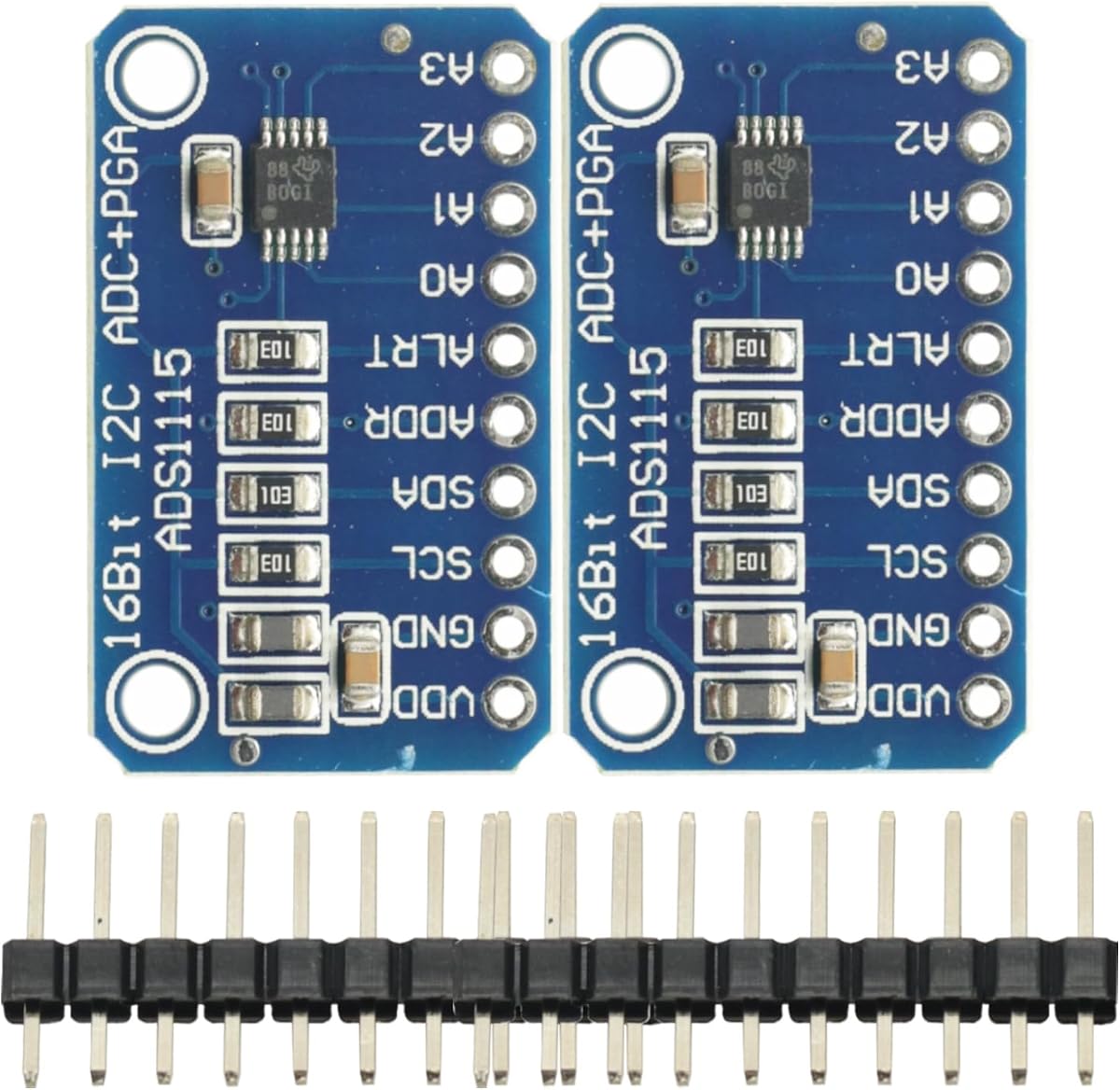
2Pcs ADS1115 16 Bit I2C Module
5.0Editor score
16-bit precision resolution
Four analog input channels
Programmable gain amplifier
This guide compares the top Arduino ADC boards for precise analog signal conversion including resolution channel count and interface options for makers and
Arduino microcontrollers lack native high-resolution analog inputs making external ADC boards essential for precise sensor measurements. These devices convert analog signals into digital data enabling accurate readings from temperature sensors strain gauges and industrial equipment.
We evaluated ten popular ADC modules based on resolution interface type compatibility and overall build quality. Our analysis covers 16-bit and 24-bit converters with I2C and SPI interfaces suitable for various project complexity levels.
Each pick highlights specific strengths use use cases helping you select the right board for your needs. Note that availability and pricing may fluctuate so verify current stock before ordering to ensure timely project completion.
5.0Editor score

4.6Editor score

4.4Editor score
The following table compares all ten selected ADC boards side by side highlighting key specifications and capabilities.




The HiLetgo ADS1256 module stands out as the top choice for precision applications requiring high resolution. With a true 24-bit ADC chip and eight input channels this board delivers exceptional accuracy for data logging and sensor measurement projects.
We may earn a commission when you buy through this link, at no additional cost to you.
Key strengths include an onboard reference voltage source and a high-speed SPI interface capable of 30ksps sampling. The low linearity error ensures consistent readings across the full input range making it ideal for calibration tasks.
Trade-offs include the need for SPI wiring which uses more pins than I2C and a higher price point than standard 16-bit modules. These are acceptable given the significant precision gains for professional and academic work.
Engineers and researchers seeking reliable 24-bit conversion should choose this module. Its robust design and stable performance make it the best premium option for demanding Arduino ADC board applications.
The 24-bit resolution captures minute voltage changes enabling detection of signals down to microvolt levels.
Eight channels allow simultaneous sampling of multiple sensors without multiplexing complications.
We may earn a commission when you buy through this link, at no additional cost to you.
This two-pack of ADS1115 modules offers outstanding value for hobbyists needing reliable 16-bit conversion. The boards include a programmable gain amplifier and support four analog input channels via a two-wire I2C interface.
We may earn a commission when you buy through this link, at no additional cost to you.
Strengths include easy integration with Raspberry Pi and Arduino due to the standard I2C protocol and wide voltage compatibility from 2 to 5.5 volts. The gain amplifier enhances sensitivity for low-voltage sensor applications.
Trade-offs are slower data rates compared to SPI boards and 16-bit precision limits. These are acceptable for most DIY environmental monitoring and simple industrial sensor projects.
Beginners and cost-conscious makers should buy this pack. It delivers excellent performance per dollar making it the best budget Arduino ADC board for general use.
I2C communication uses only two data pins simplifying wiring and saving GPIO ports.
Programmable gain allows optimization for small signal ranges improving measurement resolution.
We may earn a commission when you buy through this link, at no additional cost to you.
The Lonely Binary 3-pack of ADS1115 modules stands out for exceptional build quality and durability. Each board features ENIG gold plating that resists oxidation and ensures reliable solderability even after long storage periods.
We may earn a commission when you buy through this link, at no additional cost to you.
Key strengths include lead-free RoHS compliant construction and pre-soldered headers ready for breadboard use. The modules are logic tolerant for both 3.3V and 5V systems allowing direct connection to ESP32 and Arduino without shifters.
Trade-offs include a higher per-unit cost compared to basic boards and the inherent 16-bit limit. These are acceptable for professional educators who need reliable and safe components for repeated use.
Educators and professional designers should choose this premium option. The superior finish and safety compliance make it the best premium Arduino ADC board for classroom labs and commercial prototypes.
ENIG plating prevents corrosion ensuring long-term reliability for repeated soldering cycles.
RoHS compliant construction meets environmental standards for safe and responsible manufacturing.
We may earn a commission when you buy through this link, at no additional cost to you.
Teyleten Robot offers a three-pack of ADS1115 boards providing ample spares for larger projects. Each module includes an internal programmable gain amplifier and auto shutdown mode to reduce power consumption.
We may earn a commission when you buy through this link, at no additional cost to you.
Strengths include programmable data rates up to 860 samples per second and a wide supply voltage range. The boards support both single-ended and differential inputs increasing measurement flexibility.
Trade-offs include the need to solder headers separately and a basic PCB finish. These are acceptable given the cost savings and versatility for multi-node sensor networks.
Makers needing multiple units for IoT networks should buy this pack. It balances cost and performance effectively for general purpose Arduino ADC board tasks.
Auto shutdown mode minimizes current draw when no conversion is actively occurring.
Support for differential inputs cancels noise improving accuracy in electrically noisy environments.
We may earn a commission when you buy through this link, at no additional cost to you.
HiLetgo provides a three-pack of ADS1115 modules ideal for multi-sensor projects. Each board supports programmable gain and a comparator mode for threshold detection without continuous conversion.
We may earn a commission when you buy through this link, at no additional cost to you.
Strengths include low cost and wide voltage range allowing use with both 3.3V and 5V systems. The comparator mode enables simple alarm circuits by setting trigger thresholds in software.
Trade-offs involve manual header soldering and basic PCB finish. These are acceptable given the value for bulk deployments in robotics or monitoring systems.
Hobbyists building multiple sensor nodes should choose this pack. It delivers consistent performance at a price point that supports scaling projects economically.
Comparator mode generates interrupts when signals cross set limits enabling fast reaction alerts.
Bulk three-pack pricing reduces per-unit cost significantly for large scale projects.
We may earn a commission when you buy through this link, at no additional cost to you.
This four-pack of ADS1115 boards is designed for users needing many ADC units. Each module features an internal oscillator ensuring stable conversion timing without external clock signals.
We may earn a commission when you buy through this link, at no additional cost to you.
Strengths include low power auto shutdown and wide voltage compatibility. The boards support both differential and single-ended inputs enabling versatile sensor interfacing.
Trade-offs include manual header installation and basic PCB. These are acceptable for bulk sensor networks where cost efficiency is the priority.
Projects requiring extensive monitoring points should select this pack. It provides the necessary quantity and standard performance for distributed Arduino ADC board deployments.
Internal oscillator ensures consistent sampling rates without external crystal requirements.
Differential input support eliminates ground noise improving accuracy in long cable runs.
We may earn a commission when you buy through this link, at no additional cost to you.
The two-pack of ADS1115 I2C modules offers high accuracy for compact projects. Seven selectable input ranges enable optimization for different signal amplitudes from microvolts to several volts.
We may earn a commission when you buy through this link, at no additional cost to you.
Strengths include wide voltage operation and programmable gain. The I2C interface simplifies wiring and supports daisy-chaining multiple modules for expanded channel counts.
Trade-offs include needing to solder headers and compact size. These are acceptable for portable devices where space is limited.
Designers of portable instrumentation should choose this pack. It provides the precision and flexibility needed for accurate handheld Arduino ADC board applications.
Seven input ranges allow tuning gain to maximize resolution for specific sensor outputs.
Address pins allow chaining up to four units on one I2C bus for sixteen channels.
We may earn a commission when you buy through this link, at no additional cost to you.
Teyleten Robot AD7606 module targets high speed applications requiring synchronized sampling. All eight channels sample at the same instant enabling precise waveform capture for industrial motor and power analysis.
We may earn a commission when you buy through this link, at no additional cost to you.
Strengths include 200KHz sampling and large voltage ranges of up to ten volts. The SPI interface delivers high throughput data suitable for rapid signal monitoring.
Trade-offs include complex wiring and higher current draw. These are acceptable for professional engineering tasks where synchronization is critical.
Industrial automation engineers should select this module. It handles fast changing signals that standard I2C ADCs cannot capture accurately.
Simultaneous sampling prevents phase errors between channels in multi-sensor systems.
High sampling rate enables capturing fast transients in power electronics and motion.
We may earn a commission when you buy through this link, at no additional cost to you.
This four-pack of ADS1115 modules provides stable and reliable 16-bit conversion. Each board supports multiple sensors and integrates easily with popular microcontrollers using standard libraries.
We may earn a commission when you buy through this link, at no additional cost to you.
Strengths include wide compatibility with ESP32 STM32 and Raspberry Pi. The high precision conversion delivers accurate results for temperature pressure and voltage monitoring.
Trade-offs include basic PCB finish and header soldering. These are acceptable for makers building multi-channel systems efficiently.
DIY electronics builders should purchase this pack. It simplifies creating complex sensor arrays with consistent Arduino ADC board performance.
Compatible with most microcontrollers simplifying selection for varied development environments.
Stable readings reduce noise ensuring consistent sensor data over long periods.
We may earn a commission when you buy through this link, at no additional cost to you.
HiLetgo offers a single ADS1115 board ideal for initial prototyping. Each module includes a programmable gain amplifier and comparator mode for threshold monitoring.
We may earn a commission when you buy through this link, at no additional cost to you.
Strengths include low cost and wide voltage compatibility. The auto shutdown feature reduces power usage in battery powered projects.
Trade-offs include missing headers and basic design. These are acceptable for testing before buying larger packs.
Makers prototyping a single sensor project should try this board. It provides standard performance at an entry level price.
Single unit cost allows testing integration before bulk purchase commitments.
Auto shutdown reduces idle current extending battery life in portable devices.
We may earn a commission when you buy through this link, at no additional cost to you.
Selecting the right ADC board requires balancing resolution channel count interface and power consumption with your project goals.
Resolution defines how small a voltage change the ADC can detect. For most temperature and light sensors a 16-bit converter is sufficient. Industrial strain gauge or audio applications benefit from 24-bit resolution which reveals microvolt changes.
Prioritize 24-bit only when measuring tiny signals otherwise 16-bit saves cost and complexity.
ADC boards provide either four or eight analog inputs. Four channel modules cover most small projects. Eight channel boards are necessary for multiplexed systems or simultaneous multi-sensor arrays.
Choose eight channels only when simultaneous sampling across many sensors is required.
I2C uses two wires reducing wiring but limits speed to roughly one thousand samples per second. SPI supports much faster rates but requires four wires and more code complexity.
Use I2C for simple low speed tasks and SPI for fast data acquisition.
A built-in PGA boosts weak signals improving measurement of low voltage sensors. This feature eliminates external op-amps reducing parts count and improving reliability.
Ensure the board includes PGA for small signal thermocouples or strain gauges.
ADC input ranges vary from 0 to 5 volts or higher with bipolar options. Ensure the board matches your sensor output levels to avoid saturation.
Check the input voltage range against your sensor specification before buying.
Boards must match microcontroller logic levels such as 3.3V or 5V. Level shifting circuits add complexity and failure points.
Select boards with tolerant inputs to simplify wiring with modern boards.
Gold plated contacts resist oxidation ensuring reliable connections over time. RoHS compliant boards meet safety standards for professional deployments.
Prioritize gold finish and RoHS compliance for durable products.
Low power modes extend battery life in portable devices. Look for auto shut down or single shot conversion features.
Choose low power boards for untethered or long term monitoring.
Connect the VCC and GND pins to stable power ensuring voltage matches the board requirements. Attach SDA and SCL for I2C boards or MOSI MISO SCLK for SPI boards following microcontroller pinouts.
Install compatible libraries such as Adafruit ADS1X15 or ADS1256 libraries. Use example code to verify communication and calibrate readings against known voltage sources.
Store boards in anti-static bags to prevent electrostatic damage. Avoid excessive heat during soldering and keep headers clean for reliable contacts over time.
Many modern ADS1115 boards support logic levels from 2.0V to 5.5V so they work directly with 3.3V ESP32 or STM32 boards without level shifters. Always confirm logic tolerance in the product description before connecting to avoid communication issues.
Single-ended inputs measure voltage relative to ground while differential inputs measure the voltage difference between two signal pins. Differential mode reduces common-mode noise improving accuracy in long wire runs or electrically noisy environments.
Yes the ADS1115 offers four addressable pins allowing up to four boards on one bus for sixteen total channels. Set unique addresses using jumpers so each module responds to separate commands without conflicts.
Calibrate using a known reference voltage to offset drift. Use stable power supplies with decoupling capacitors near the ADC pins. Filter noisy signals with RC low pass circuits before they reach the converter.
SPI boards like the ADS1256 and AD7606 offer tens of thousands of samples per second while I2C ADS1115 boards typically max at 860 samples. Choose SPI for audio or vibration analysis requiring high speed.
Yes the Raspberry Pi lacks native analog inputs making these ADC boards essential. I2C and SPI connections match Pi GPIO pins and Python libraries exist for easy integration in automation projects.
The PGA amplifies small input signals enabling measurement of millivolt range sensors like thermocouples. Without gain the small signals occupy only a fraction of the ADC range reducing effective resolution.
Yes boards with auto shut down or single-shot mode minimize power draw when idle. Select modules supporting low current sleep modes for battery powered remote sensors to extend device lifetime.
This roundup compares top ADS1115 ADS1256 and AD7606 boards covering various resolutions and interfaces. The 24-bit ADS1256 leads for precision while the ADS1115 packs deliver best value for general use.
Prioritize resolution and interface type based on your sensor needs. For industrial automation choose SPI high speed boards. For hobbyist projects I2C ADS1115 boards offer the best balance.
Remember to verify current stock and compatibility before ordering. Prices and availability change so check listings directly on retailer sites to ensure you receive the right board for your project.