
Loto OSC482 Series
5 in 1 functionality
20MHz bandwidth
USB PC integration
Finding the right PC oscilloscope is essential for engineers and hobbyists who need precise signal analysis without bulky bench equipment. These devices connect directly to your computer, offering powerful software interfaces that enhance visualization and measurement capabilities. Whether you are debugging circuits or analyzing audio signals, a quality unit ensures accurate data capture.
We evaluated ten leading models based on bandwidth, sampling rates, channel counts, and software compatibility. Each product was reviewed for its ability to integrate smoothly with Windows or Linux systems. Our goal is to highlight units that balance performance with portability and ease of use for various technical applications.
Every pick in this list showcases specific strengths tailored to different user needs and budgets. You will find options ranging from DIY kits to professional automotive diagnostic tools. Please note that pricing and availability can change frequently, so check current listings before making your final decision.
4.8Editor score

4.7Editor score
As an Amazon Associate we earn from qualifying purchases.
This side-by-side comparison outlines the core specifications of each model to help you quickly identify the right fit for your technical requirements and budget constraints.


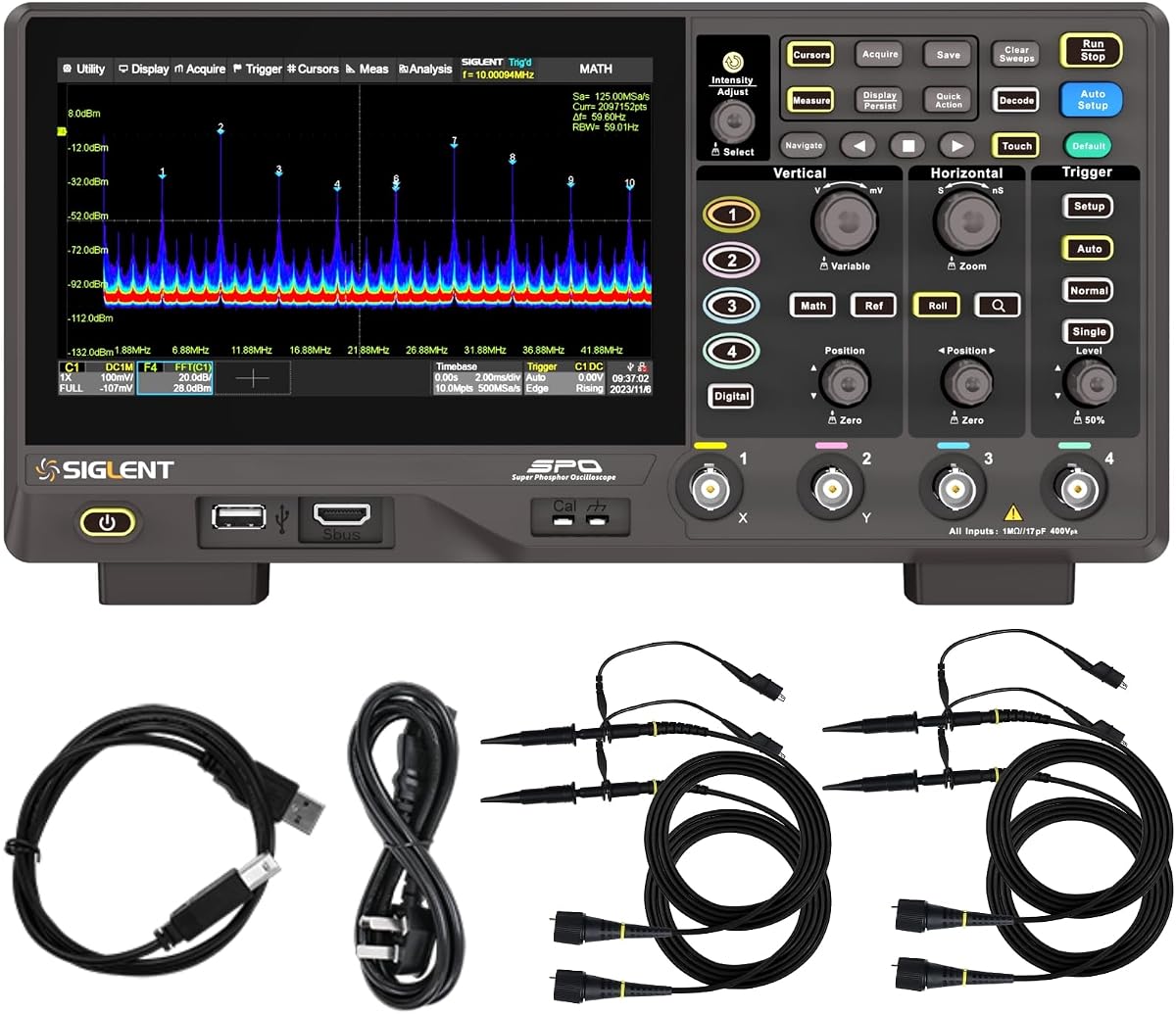
The Siglent SDS814X HD stands out as a top-tier option for users needing deep analysis. With a 4.8 rating, it combines 100MHz bandwidth with 4 analog channels and 12-bit resolution. Its large touchscreen and high memory depth make it ideal for complex signal tasks.
We may earn a commission when you buy through this link, at no additional cost to you.
This device offers 2GSa/s sampling and up to 50Mpts memory depth. The waveform capture rate reaches 80,000 wfm/s in normal mode. It supports adding 16 digital channels if you buy the specific logic probe and option. The interface is intuitive and reduces the learning curve significantly.
While the logic channels are sold separately, the analog performance is unmatched in this class. The 12-bit converter provides clearer signal details than standard 8-bit models. This extra resolution is crucial for low-amplitude noise analysis in modern electronics.
Engineers and advanced hobbyists should buy this for its balance of depth and speed. The touch interface speeds up measurements compared to physical knobs alone. It is a reliable investment for professional labs needing precise PC-based analysis.
The 12-bit analog to digital converter delivers superior signal clarity compared to standard 8-bit scopes. This helps in spotting small noise variations in power supplies and audio circuits.
With 50Mpts memory depth, you can capture longer waveforms without losing detail. This is essential for debugging intermittent faults that occur over extended periods.
We may earn a commission when you buy through this link, at no additional cost to you.
The Siglent SDS1202X-E is a powerful choice for users who need higher bandwidth. It achieves 200MHz bandwidth which is double many entry-level units. The 1GSa/s sampling rate ensures accurate capture of fast rising edges and digital signals.
We may earn a commission when you buy through this link, at no additional cost to you.
This model includes standard serial bus triggering for I2C, SPI, UART, and more. The 14Mpts record length allows detailed zoom-ins on long captures. It is a solid device for embedded developers needing protocol analysis without extra hardware.
Trade-offs include having only 2 channels instead of 4. Also, it relies on physical controls rather than a touchscreen. However, for its price point, the performance per dollar is excellent for bench work.
If you work with fast digital signals, this is a great choice. The serial decoding saves time compared to manual triggering. It fits well in a desktop lab setup where budget matters.
200MHz bandwidth handles fast signals better than standard units. This is crucial for modern microcontrollers and RF designs.
Standard decoding for common protocols like I2C and SPI means you can analyze bus traffic directly on screen.
We may earn a commission when you buy through this link, at no additional cost to you.
The Loto OSC482 Series is an affordable solution for hobbyists and students. It functions as a scope, generator, and logic analyzer. With 20MHz bandwidth, it covers basic electronics repair and educational needs effectively.
We may earn a commission when you buy through this link, at no additional cost to you.
It offers 50MS/s sampling and variable resolution from 8 to 13 bits. The ability to add signal generator or logic analyzer modules makes it versatile. This modular approach saves money compared to buying separate units.
The main trade-off is the lack of a standalone screen. You must connect it to a PC for viewing. Also, 20MHz limits its use on high-frequency RF work. For audio or low-speed DC circuits, it is sufficient.
Students and hobbyists should consider this for its value. It teaches basic signal concepts without breaking the bank. The PC interface is clean and easy to use.
Combining a generator and analyzer in one box reduces bench clutter. This is perfect for small workbenches.
Since it requires a PC, it is not standalone. Ensure your laptop has USB ports before buying.
We may earn a commission when you buy through this link, at no additional cost to you.
The Owon VDS1022I focuses on portability and safety. Its USB isolation protects your computer from electrical surges during testing. This is a vital feature when working with ungrounded mains circuits.
We may earn a commission when you buy through this link, at no additional cost to you.
With 100MHz bandwidth and 1GS/s sampling, it handles decent speed tasks. The UI shows FFT and waveform views on the same screen. This helps in visualizing frequency components instantly.
Trade-offs include fewer trigger types than bench scopes. It is strictly a USB device requiring PC power. However, the thin body makes it easy to carry to site.
Field technicians needing safety features should choose this. The isolation prevents damage to laptops. It balances portability with decent bandwidth specs.
Built-in isolation protects your PC from high voltages. This extends the life of your laptop while testing live circuits.
Showing FFT and waveforms together helps you spot harmonics. This simplifies audio and power quality analysis.
We may earn a commission when you buy through this link, at no additional cost to you.
The Autel MaxiScope MP608 is specialized for vehicle diagnostics. It offers 4 channels to monitor multiple sensors at once. The 12-bit resolution captures precise signals for ignition and actuators.
We may earn a commission when you buy through this link, at no additional cost to you.
It supports decoding for CAN, CAN FD, and LIN protocols. Guided test procedures help technicians find faults faster. This removes the guesswork from complex automotive electrical repairs.
While excellent for cars, it is costly for general electronics. The auto probe configuration saves setup time. You still need a tablet or PC to run the software.
Auto repair shops will benefit most from this tool. The guided library simplifies learning new systems. It is a professional grade asset.
Decoding CAN and LIN protocols helps identify network faults easily. This is essential for modern vehicle diagnostics.
12-bit resolution catches tiny signal noise that 8-bit scopes miss. This helps in finding intermittent electrical faults.
We may earn a commission when you buy through this link, at no additional cost to you.
This upgrade builds on the MP408 with better firmware and features. It includes auto probe calibration to prevent setup errors. This ensures accurate measurements without manual tuning each time.
We may earn a commission when you buy through this link, at no additional cost to you.
The package contains a full accessory kit including probes and clamps. It works with many MaxiSys tablets and PCs. This versatility allows mechanics to integrate it into their current workflow.
The high price is justified by the full kit included. Auto calibration saves valuable time in the shop. However, you must own a compatible tablet to use it.
Professional mechanics should buy this for reliability. It reduces repeat tests due to bad setup. The included accessories save extra costs.
The unit automatically configures probes for accurate readings. This eliminates human error in setup steps.
Having all probes and clamps included ensures you are ready to test. This avoids buying extra parts separately.
We may earn a commission when you buy through this link, at no additional cost to you.
The Siglent SDS1104X-E offers 4 channels which is rare at this price point. It handles 100MHz signals well and includes standard serial decoding. This makes it versatile for mixed signal debugging.
We may earn a commission when you buy through this link, at no additional cost to you.
Its 4 channels allow monitoring four inputs simultaneously. This is useful for motor control or power supply testing. The serial decoder supports I2C and SPI without extra keys.
It is heavier and less portable than USB units. It requires a dedicated bench setup mostly. But the performance justifies the weight for lab work.
Lab technicians needing multiple channels will find it ideal. The four inputs speed up comparative measurements. It is a robust addition to any test station.
Using four channels at once cuts test time in half. This is great for complex system analysis.
Built-in decoding for I2C and SPI removes need for extra hardware. This saves cost and setup complexity.
We may earn a commission when you buy through this link, at no additional cost to you.
The DSO 138 is a kit that requires assembly by you. It features a small 2.4 inch color screen. It is designed for students learning electronics principles.
We may earn a commission when you buy through this link, at no additional cost to you.
Assembly helps you understand how oscilloscopes work internally. The 1MSPS rate suits low frequency signals like audio. It fits in a pocket for easy carrying around.
It is not for professional high frequency work. You need soldering skills to build it. But for education, it is excellent value.
Teachers and hobbyists should use this for training. It turns abstract concepts into tangible tools. The low cost allows multiple units for a class.
Building the kit teaches component values and circuit theory. This is far more educational than buying pre-made units.
Open source allows modifications and custom software. This encourages experimentation beyond standard limits.
We may earn a commission when you buy through this link, at no additional cost to you.
This unit offers 5 channels for simultaneous monitoring. It supports WiFi connection to PC or Android devices. The 4.3 inch screen provides good viewing area for waveforms.
We may earn a commission when you buy through this link, at no additional cost to you.
Wireless connection means you are not tied to USB cables. It weighs only 350g and has a battery for three hours. This makes it handy for mobile testing.
The 3Msps rate is limited for high speed data. It is better for low frequency signals like audio. The screen is useful when no PC is nearby.
Users needing flexible connectivity should consider this. It works well for sensor logging. Just note the bandwidth limits on sampling speed.
Wireless links allow you to place the scope away from the PC. This is great for high voltage testing setups.
Built-in battery provides hours of testing. This ensures work continues without wall power nearby.
We may earn a commission when you buy through this link, at no additional cost to you.
The Korg Nu:Tekt NTS-2 is a DIY kit for musicians and creators. It assembles easily without soldering. It includes a 4-channel scope for audio signals.
We may earn a commission when you buy through this link, at no additional cost to you.
It acts as a spectrum analyzer to visualize sound frequencies. The waveform generator creates custom signals for testing. The interface is intuitive and clean for audio use.
It is not suited for general electronics repair work. Its design is specific for audio and creative tasks. But it offers a unique learning experience.
Musicians and audio engineers will find this useful. It adds visual precision to audio setup. It bridges the gap between audio and oscilloscopes.
The tool is tuned for audio signals and frequencies. This makes it perfect for studio environments.
No soldering means quick assembly without special tools. This lowers the barrier for entry for non-engineers.
We may earn a commission when you buy through this link, at no additional cost to you.
Choosing the right PC oscilloscope requires understanding key technical parameters that affect signal accuracy. We break down the most important factors below to help you match specs to your specific needs.
Bandwidth determines the highest frequency you can measure. A scope should have at least 5 times the bandwidth of your signal for accuracy. For general electronics, 50MHz to 100MHz is often sufficient.
Always select a bandwidth higher than your expected signal frequency to avoid distortion.
Sampling rate is how many times the device captures data per second. Higher rates allow you to see faster edges and details. 1GS/s is standard for digital work.
Aim for a sampling rate at least 4 times your bandwidth for reliable waveforms.
Most models offer 2 or 4 channels. If you need to compare multiple signals simultaneously, 4 channels are ideal. Some USB models can expand channel count with options.
Choose a model that fits your typical test setup without needing extra adapters.
Memory depth affects how much data you can store at once. More memory helps capture long signals without losing detail. Units like 14Mpts to 50Mpts are good for diagnostics.
Higher memory depth is crucial for analyzing intermittent faults over time.
Standard scopes use 8-bit ADCs. Higher resolution models like 12-bit show more voltage detail. This helps in spotting noise on power rails or audio signals.
If analyzing low amplitude signals, prioritize higher bit resolution.
PC oscilloscopes rely on software. Check if the software works on your operating system. Look for features like serial decoding or waveform export tools.
Ensure the software is stable and supports data export to Excel or CSV.
USB is standard but WiFi is emerging for mobile use. Consider if you need isolation for safety when probing mains. A thin body helps if you travel to job sites.
Select connectivity that matches your workflow; USB is simpler while WiFi offers freedom.
Prices vary widely from kits to professional units. Kits teach principles but lack performance. Professional units cost more but offer better longevity and specs.
Match your budget to your skill level; beginners can start with lower cost units.
Start by connecting the scope to your PC via USB. Install the drivers provided by the manufacturer to ensure smooth communication. Calibrate the probes before measuring to avoid offsets.
Keep the device in a dry environment and avoid dust on the ports. If your model has a screen, clean it gently with a soft cloth. Do not use harsh chemicals that could damage the surface.
Store the device with its probes coiled neatly to avoid cable damage. Regularly update the software to get new features and bug fixes. Following these habits extends the device lifespan.
Many units support Windows primarily but some have Linux drivers. Check the product specs for OS compatibility. Some vendors offer Mac support though it is less common.
Yes, models like the Autel MaxiScope are designed for it. They have automotive protocols built-in. Standard USB scopes may require extra adapters for high voltage.
Isolation protects your computer from high voltage surges. It is critical when testing mains circuits. Look for USB isolation features before connecting to live equipment.
Most software allows saving to CSV or image files. You can export data for further analysis. Check the documentation for specific save steps.
Bandwidth is the signal frequency limit. Sampling rate is how often data is captured. Both affect accuracy but sampling rate handles fast edges better.
Most units require a PC or tablet to run software. Some newer portable models have built-in screens. But the core value lies in PC integration.
We have reviewed ten excellent options ranging from professional benches to educational kits. The Siglent SDS814X HD leads in resolution while the Loto OSC482 offers great budget value.
Prioritize bandwidth and channel count based on your typical tests. If you need automotive features, look at the Autel models. Otherwise standard USB scopes work well for general electronics.
Prices change often so verify current deals before buying. Ensure the warranty and support are available in your region. With the right tool your diagnostics will be more efficient.